
Mining is a foundational industry in Utah.
Circling the rotunda in the Utah State Capitol building is a cyclorama that depicts eight important scenes from Utah’s territorial years. Along with depictions of pioneers building irrigation systems and the driving of the Golden Spike, is a painting titled “General Connor Inaugurates Mining.”
 The panel shows U.S. Army Maj. Gen. Patrick E. Connor in the midst of a rudimentary mining operation. General Connor, often referred to as the “Father of Utah Mining,” organized Utah’s first mining district on Sept. 17, 1863, which encompassed the east side of the Oquirrh Mountains.
 Utah’s first mining district is still its most productive, as it is home to Rio Tinto Kennecott’s Bingham Canyon Mine, one of the largest copper mines in the world.
In what might be considered one of Utah’s first economic development incentives, before Utah was a state, the territorial legislature offered a cash prize to anyone who discovered a recoverable coal source within 40 miles of Salt Lake City.
Many communities around our state were founded to support the development Utah’s vast and diverse mineral resources. Utah’s modern mining industry continues to sustain many of those same communities today, as well as making a substantial contribution to the state’s overall economy.
According to data compiled by the National Mining Association, Utah’s mining industry contributed $5 billion to the state’s gross domestic product and supported over 41,000 jobs in 2018.
Utah ranks eighth in the nation for non-fuel mineral production (base metals, precious metals and industrial minerals), and 12th in the nation for coal production.
Utah’s mineral production increased 14 percent in 2018, after having grown 9 percent the year before. Last year, Utah produced $1.7 billion in base metals, including molybdenum, beryllium, magnesium and copper, with copper accounting for 78 percent of the total base metal production value. Utah also produces precious metals, with $289 million in gold and silver production in 2018.
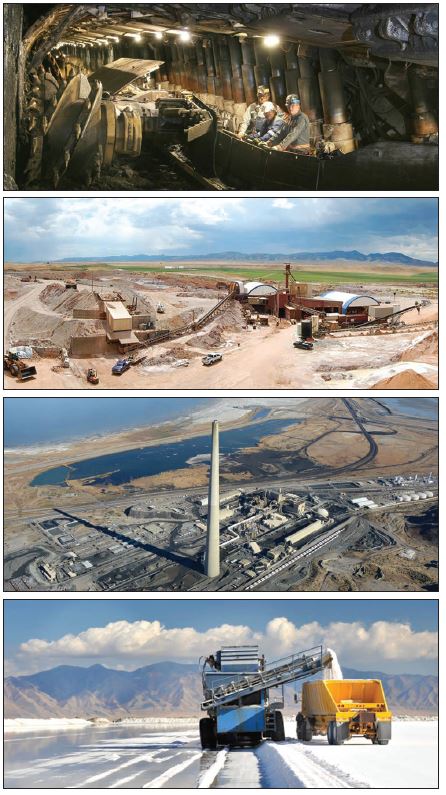
Utah produced $1.2 billion in industrial minerals in 2018, including phosphate, potash, lime, cement, salt, Gilsonite, clay, gypsum and others. These operations are spread throughout the state and the minerals they produced are used in a variety of agricultural, industrial, extractive, manufacturing and other industries.
Utah has substantial uranium and vanadium reserves. The White Mesa Mill in San Juan County is the only operating uranium mill in the nation and is currently producing vanadium and processing alternate feeds from other producers and sites around the county.
Utah also has some of the largest unconventional fuel resources in the world. The Uintah Basin contains massive reserves of both oil shale and oil sands, both of which continue to be developed by a number of operators.
Utah produced nearly 14 million short tons of coal last year — valued at $454 million — from eight mines producing on coal leases in Carbon, Emery, Sevier, Sanpete and Kane counties. Notably, Utah coal producers exported 4.6 million short tons of coal to the Asian market, the largest amount since 1996.
Utah is the only state in the nation that produces magnesium metal, beryllium concentrate, potassium sulfate and Gilsonite. Magnesium, beryllium and potash are included on the Department of Interior’s list of minerals that are considered critical to the nation’s economic and national security. Utah also has proven reserves or historical production of a number of other minerals on the critical-minerals list.
Although Utah’s total mining employment is not as large as other sectors, such as manufacturing or business and professional services, it leads the state in terms of average wages.
According to data from the Utah Department of Workforce Services (DWS), the average monthly wage for workers in the Utah mining industry (for which DWS includes the both mineral and oil and gas extractive sectors) was $6,449 in 2018. That is higher than professional/business services ($4,934), financial activities ($5,659), manufacturing ($4,817) and even information/IT ($6,381).
The positive economic impact of Utah’s mining industry is especially pronounced in the rural parts of our state. In many rural counties, mining operations are among the largest employers and largest taxpayers. Mining operations not only provide direct employment, tax revenue and mineral royalty revenue, they also support an array of jobs in direct service industries such as transportation, logistics, equipment supply and repair, heavy construction, industrial consumables and many more.
Mining industries also provide wages that are substantially above average county wages, and even (as discussed above) statewide average wages. For example, according to DWS data, average monthly wages for mining workers in Carbon County in 2018 were $7,542. That is 124 percent higher than the average month wage ($3,370) in the county. In Emery County, average monthly mining wages were 61 percent higher than the county average monthly wage in 2018. In Sevier County, mining wages are 91 percent higher and in San Juan County it's 106 percent.
Some public policy entities in Salt Lake City promote the idea of “replacing” mining jobs in rural Utah with jobs in the tourism and hospitality industries. The data from DWS show why this is an unworkable proposition.
Mining jobs in Carbon County paid 639 percent more than jobs in the leisure and hospitality industry in 2018 ($7,242 average monthly wage vs. $1,020). In Emery County, mining jobs paid 358 percent more. Even in counties with more well-developed tourism industries, wages in mining still provided far greater wages to workers. In Grand County, mining wages were 207 percent higher than leisure/hospitality wages in 2018. In San Juan County, it was 203 percent.
Simply put, mining jobs provide family- and community-sustaining wages, especially in rural Utah.
Of course, no one should argue against economic diversification in any part of Utah’s economy. Improving tourism infrastructure, recruiting new industries, increasing education and workforce training options, incentivizing tele-work for tech and other jobs that could be performed off the Wasatch Front and promoting entrepreneurship and small-business formation are all efforts that should continue to be pursued to strengthen Utah’s rural economies.
However, economic development activities should be additive, not subtractive. We should be looking to supplement and diversify rural economies, not to replace industries and jobs that have sustained those economies for generations. Efforts to promote rural economic development that do not include plans to support traditional industries like mining, oil and gas, energy production, manufacturing and agriculture will not succeed.
Despite any popular perception to contrary, mining is a growth industry. Why? Because demand for minerals increases as technological innovation increases. For example, it is estimated that early cell phones from the 1980s used 25-30 different minerals. The smartphones of today can use up to 75 different mineral elements.
Every time you use your smart- phone to take a photo or video that gets uploaded to the cloud, you increase the need for data storage, which increases the need for reliable electricity to power the data centers that hold those bytes — not to mention the copper and other mineral contained in rows and rows of data servers, the minerals used to construct the building itself, the minerals used in the utility infrastructure to support the building, and on and on.
The modern lifestyle we enjoy is simply not possible without mining. From its earliest territorial days, mining has been critical to Utah’s economy and the robust economic growth our state is experiencing today cannot continue without it.
Brian Somers joined the Utah Mining Association as its president in 2019. Somers has over 20 years of experience in legislative affairs, strategic communications and executive leadership. Prior to UMA, he led the Utah Science Technology and Research Initiative (USTAR) as its managing director.