
The 5.7-magnitude earthquake that shook the Wasatch Front on March 18 wasn’t quite “the big one” that looms large in Utahns’ imaginations, but it was intense enough to prompt an assessment of its effect on numerous structures where people work, gather and play.
 Fortunately, some of Utah’s oldest and most revered architectural treasures, built long before stringent seismic standards became common practice, endured this test-run earthquake with distinction, thanks to the foresight and planning in recent decades that led to comprehensive base-isolation renovations preserving their stability.
Post-earthquake inspections of both the Utah State Capitol and the Salt Lake City & County Building showed that their base isolators (finished in 2008 and 1989, respectively) did their job. Each of these iconic buildings held up remarkably well due to planning throughout Utah.
There are large logistical and cost barriers to doing base isolation on existing buildings, said Paul Lawrence, who has extensive seismic work experience as a project manager for Jacobsen Construction Co., the general contractor which performed the base isolation work on both the Capitol and the Salt Lake City & County Building. Lawrence says that’s why base isolation renovations are usually only done “for very sensitive buildings that have to stay in operation in emergencies,” — such as the Capitol — or for buildings that must be carefully preserved “for the historical value alone.”
Lawrence is currently advising and managing Jacobsen’s seismic work for the Salt Lake Temple, which features prominently in the four-year Temple Square historic renovation project for The Church of Jesus Christ of Latter-day Saints. “Base isolation is intricate, and there is so much to consider with an existing building, let alone a historic one,” said Lawrence.
“When you’re doing it on an existing building, you need to analyze the structure and determine at what elevation in the building, and at what point in the building, you need to construct the base isolators,” said Brent Rowley, another experienced project manager for Jacobsen who is currently overseeing seismic work at the Salt Lake Temple.
On top all of that careful planning, a protocol must be put in place to ensure that disconnecting the building’s heating, electrical and plumbing systems during base isolation work is done in a way that doesn’t harm the long-term environmental control on the building, Lawrence said.
“It’s kind of like open-heart surgery. We have to cut all the mechanical and electrical away from the building, but we can’t let the building die while we do that surgery,” Lawrence said. “Doing that is an important, complex part of the process.”
Base isolation is also frequently completed for facilities such as medical campuses and data centers, which cannot have operations interrupted without catastrophic results, Lawrence said. For new buildings of that kind, base isolation work is much simpler and less cost-intensive.
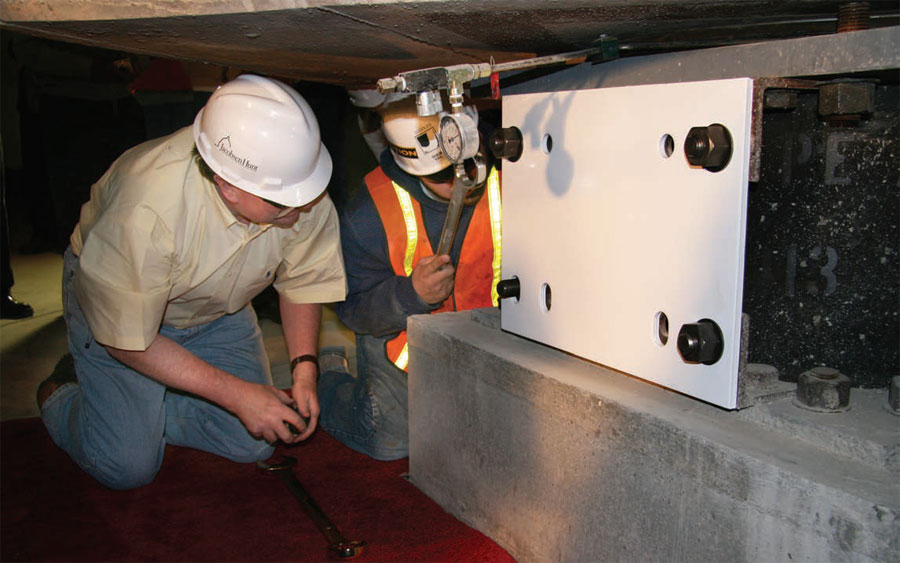
Construction workers examine a base isolator that was installed as part of a major seismic renovation to the Utah State Capitol.
“In new construction it’s pretty easy — you just start building from the ground up, starting with the base isolation system,” Rowley said.
Any construction team doing base isolation work needs to partner with the right engineering experts to ensure the high-stakes project is completed as intended, Rowley said.
“You definitely need the right team looking at the risks,” he said. “The structural engineer selection is critical and the experience they have in this kind of work is critical.”
Lawrence agreed. “A brilliant engineering team is critical when it comes to really knowing how to do it and how we put together the load transfers and all the technical parts of it,” he said. “Without that you’d be lost. You’ve really got to have the right heads to know how to do this kind of work.”
Another key ingredient, he said, is “skilled craft workers who have good experience in base isolation and who know how to operate inside the spaces where they need to be.”
Lawrence said everyone who cherishes Utah’s most iconic historical buildings can be grateful that civic leaders and others have taken the long view by commissioning renovations for which the biggest payoff may still be up to several decades down the road. Planting seeds that future generations will harvest — that’s the kind of community attitude that will prevent exacerbating an earthquake tragedy in the years ahead, according to Lawrence.
“We’re overdue for a 7.2-magnitude earthquake on the Wasatch Front, so the seismic design of buildings has to be taken seriously or you’ll have all kinds of issues when the earthquake comes. And thankfully, it has been taken seriously,” he said.
Base isolation: What is it, and how does it work?
All buildings constructed in Utah since the 1970s are required by law to meet certain minimum seismic requirements. But “when we get into what we call base isolation, it’s a whole new meaning far and beyond typical seismic work,” Rowley said.
Base isolation is the most comprehensive, complete way to protect against earthquakes. It is performed by installing base isolation systems on which the buildings rest. With the building resting on these footings alone, earthquake damage is minimized because the footings’ design enables them to greatly absorb and minimize the motion of the earth beneath — largely stopping that motion and energy from reaching the building above.
“It’s decoupling the movement of ground forces from the structure,” Lawrence said.
With today’s computer technology, engineers are able to seismically model a building, simulate a seismic event and then design the appropriate base isolation system. Utilizing a temporary load transfer system, a new base isolation system is constructed and the structural loads of the building are then transferred back to the new base isolation system.
Afterward, construction teams monitor the building to ensure the process was done as precisely as intended.
“We put seismic monitors on the buildings to see what the building would do if there’s an earthquake,” Rowley said.
Getting base isolation right the first time is essential, and as such, it is the kind of work that requires patience, planning and expertise from everyone involved. Much of the work involved in base isolation happens well before construction crews are on-site.
“It takes a significant amount of planning,” Lawrence said. “The isolation bearings can take a year or more to precure, and depending on the type of bearing, they can be proprietary.”
Paul Lawrence is a project manager with Jacobsen Construction in Salt Lake City where he has worked in many positions over the past 21 years, including project superintendent and senior estimator.
Brent Rowley is also a project manager at Jacobsen. He has served in leadership roles on manymajor projects, such as the City Creek Center, in his 33 years with the company.