
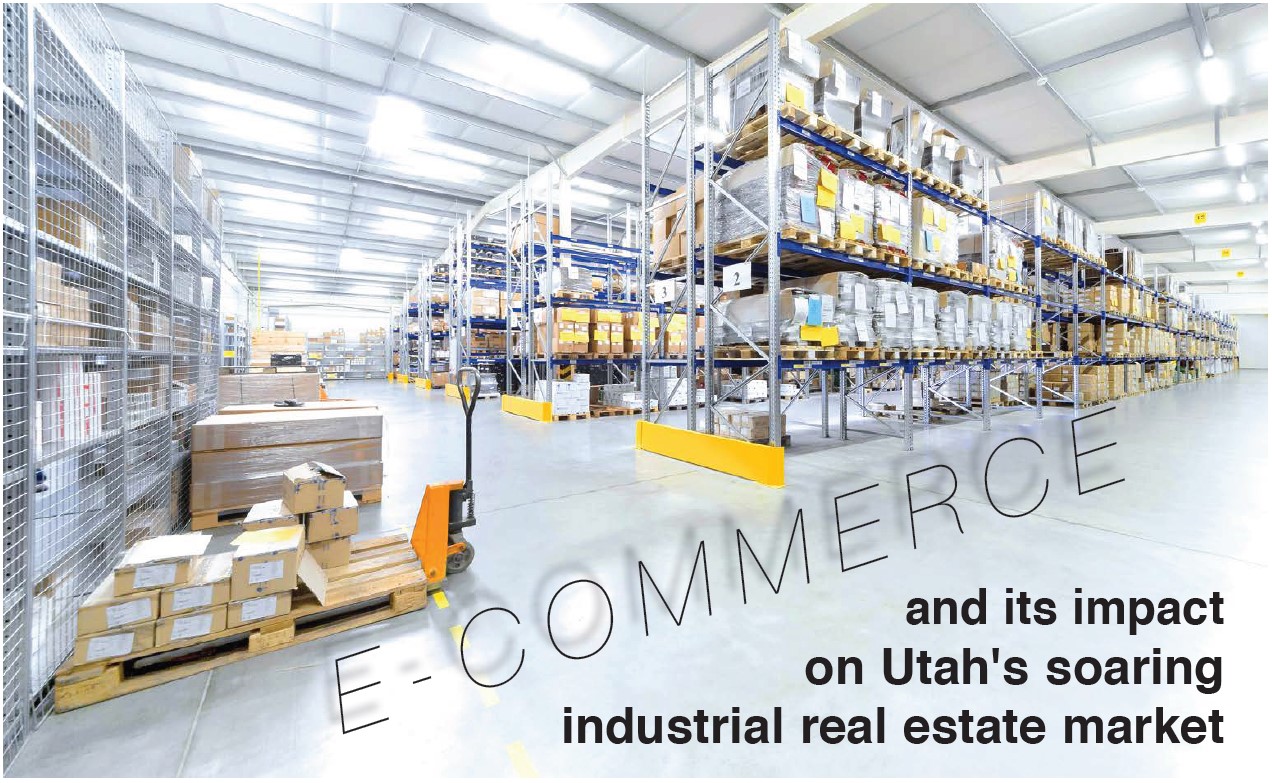
 For the past decade, the industrial sector has been one of commercial real estate’s shining stars. Though new industrial buildings seldom draw the attention that a new skyscraper might, the local — and national — industrial market has been red hot and shows no signs of slowing down.
One of the key reasons for this ever-strengthening sector is the impact of e-commerce. E-commerce is driving robust industrial and logistics property demand across the nation and Utah is benefiting from this phenomenon as well.
How does e-commerce affect commercial industrial space? Simply put, the more purchases made online (e-commerce), the greater the need to produce, house and move those products throughout the globe (manufacturing, warehousing, shipping). To accommodate today’s two-day shipping expectations, companies need to have warehouses located near major markets, which has contributed to the widespread growth for industrial and logistics product. Consumers in rural America are just as keen on receiving their orders quickly as those who live in major metropolitan areas. As a result, industrial space has expanded to make product more accessible to markets throughout the globe instead of being primarily localized near major shipping ports and transportation hubs.
In June, CBRE published a “Global E-Commerce Outlook” report to shed some light on the e-commerce sector as a whole and highlight what’s driving growth in different markets throughout the world. The analysis included studying 43 global markets, exploring 27 factors driving e-commerce, identifying six key drivers that best explain e-commerce penetration, creating an index to measure the strength of these drivers in different markets and forecasting e-commerce penetration in each market and the additional logistics space required to satisfy demand. Within this analysis, five key themes were explored to determine the overall impact that e-commerce has had on the industrial and logistics market. A brief overview of the main findings for these key themes is included below.
1. Recent Growth of E-Commerce
Over the past five years, there has been a remarkable 140 percent increase in global e-commerce sales. In dollars, this represents a growth from $1 trillion in 2015 to $2.4 trillion in 2020. Mainland China and the U.S. are the biggest e-commerce markets in the world, accounting for 57 percent of global Internet sales.
2. What Factors are Driving E-Commerce Growth?
To answer this question, CBRE explored 27 factors and divided the top ones into four basic categories: demography, usage, cultural payment preference and infrastructure access.
Demography included things like urban population, population density and employment in services fields. Usage looked at the digital skills or the population, its Internet usage, mobile Internet sales shares and whether a population was a dominant e-commerce player. Then, moving to cultural payment preference, things like credit/debit card use, digital payments and online bill pay were analyzed.
Lastly, infrastructure access explored the number of fixed broadband subscriptions in a market, its transportation infrastructure and the timeliness of shipments in the area.
All these factors were used to determine how prepared an economy was to support e-commerce, and the takeaways were that the following were the most prominent e-commerce drivers:
• Demographics: percentage of urban population.
• Usage: digital skills of population, mobile Internet ratio and dominant e-commerce player.
• Cultural: credit and debit card use.
• Infrastructure: fixed broadband subscriptions.
3. Impact of COVID-19
As could be expected, Internet sales have increased rapidly during the pandemic with a lasting effect. Markets with a stronger presence of e-commerce drivers experienced higher peaks of online penetration during the pandemic.
4. Will E-Commerce Continue to Grow?
By predicting how the six key e-commerce drivers will evolve over time in different markets, CBRE produced a forecast of e-commerce penetration rates for major global markets, all of which were forecasted to increase. E-commerce penetration will continue to grow in established markets, while less-established markets will gradually catch up as the presence of e-commerce drivers in these markets is increasing.
5. Impact on Logistics Property
When looking at the global forecast for logistics space requirements, it is estimated that e-commerce sales will increase by $1.5 trillion to reach $3.9 trillion by 2025, with an additional 138 million square meters — roughly 1.5 billion square feet — needed to support this growth.
When adding everything together, the key points taken from this report were:
• E-commerce has rapidly grown globally over the past five years.
• Certain key factors including demography, usage, cultural and infrastructure factors are driving e-commerce growth.
• Due to COVID-19, Internet sales in most markets rapidly increased in 2020 with a lasting effect.
• Markets with a stronger presence of e-commerce drivers experienced higher growth of e-commerce during the pandemic.
• E-commerce penetration will continue to grow in both established and non-established markets as the presence of e-commerce drivers gradually increases in all markets.
• Over the next five years globally, 138 million square meters — roughly 1.5 billion square feet — of additional e-commerce-dedicated logistics space will be required to support the growth of Internet sales worldwide.
So how has e-commerce affected Utah’s industrial and logistics market?
When considering the Salt Lake metro, e-commerce penetration has certainly contributed to the area’s sector-based growth. As of the first quarter of this year, high demand levels have aided vacancy rates in dropping below 3 percent (currently at 2.6 percent). This high demand has created challenges for new and expanding users throughout the market area. Though there’s a strong construction pipeline, with 1.4 million square feet delivering in the first quarter alone, early preleasing levels reinforce the continuing demand within the market.
In addition, several factors like population growth, a new airport, record speculative construction and strong leasing levels are also aiding Salt Lake’s industrial market in continuing its robust performance. When factoring in the growth forecasts for e-commerce, it’s easy to see how the combination of a strong e-commerce sector with Utah’s top-ranked economy have the potential to keep the local industrial and logistics market expanding for years to come.
Building off the momentum of the past 10 years, Salt Lake is poised for continued industrial and logistics growth. Demand is elevated; construction remains robust, with 7.6 million square feet currently in the pipeline; e-commerce is projected to grow even further; and vacancy rates continue to fall. The market is pushing forward and has no indication of slowing down anytime soon, so sit back and enjoy the ride.
Chris Liddell is a vice president in CBRE’s Salt Lake City office who specializes in industrial and logistics.