
Gov. Gary Herbert likes to brag about Utah having the nation’s most-diverse economy. That same diversity is manifesting itself in the state’s energy industry, where renewable resources are emerging from once-minuscule levels.
Speaking at the Governor’s Energy Summit in late May in Salt Lake City, Herbert noted that Utah now is a hub for both traditional and renewable energy resources.
“While conventional fossil fuels make up the foundation of Utah’s affordable and reliable baseload of power, the state’s energy portfolio is growing more and more diverse,” he said.
Just a few years ago, 85 percent of energy produced in Utah was from coal, while less than 1 percent was from renewable sources. The rest was from natural gas. Now, renewables account for nearly 11 percent and are “rising fast,” he said.

What’s more, he said, new technologies and investments are making fossil fuel energy cleaner. Utah’s energy portfolio has reduced its carbon footprint by about 15 percent in the past decade despite Utah’s large population growth.
Laura Nelson, the governor’s energy advisor and executive director of the Governor’s Office of Energy Development, said Utah has seen over $2 billion in renewable energy investments, and the solar industry alone employs more than 6,000 people in the state.
Among the companies boosting the renewable-energy figures is Dominion Energy, which has operations in 18 states and serves nearly 7.5 million customers. Thomas Ferrell, chairman, president and CEO, said the company in 2014 had a total of 1 megawatt of solar generation, or enough to power 250 homes. Now it has about 2,600 megawatts. In Utah alone, it has eight solar projects totaling 580 megawatts, representing an investment of just under $1 billion, he said.
The company also is involved in a process to convert food waste into methane that can be used to heat homes and run businesses, and a project that captures waste methane from hog farms.
“Energy and innovation are the two most important, the two most fundamental, forces behind modern humans’ well-being,” Ferrell said.
“Shifting from legacy generation sources, such as coal and natural gas, to solar and wind has helped us cut carbon emissions from our power stations by over 50 percent in just the last 14 years, and that’s about twice the industry average,” he said.
And most of the changes have occurred not because of government regulation but instead through technological advancements, he added. The company’s goal is to cut carbon emissions by 80 percent by 2050 and methane emissions in half by 2030 — the latter being equivalent of taking over 3 million cars off the road for a year. “Again, not a government mandate, like our carbon target,” Ferrell said. “It is a voluntary goal that we’ve set for ourselves.”
Rick Perry, U.S. secretary of energy, commended Utah’s actions that have helped the U.S. rise to global energy supremacy during the past 15 years. “You all have contributed to one of the most remarkable stories of our lifetime,” he told the crowd.
“We’re now producing more energy more abundantly, more affordably and, I might say, more cleanly and efficiently than ever before, and we’re obtaining it from this wider range of sources than anyone ever thought possible,” he said.
In 2005, he said, experts said all energy resources had been found and if any more were discovered, it would be “exorbitantly expensive” to extract. Instead, inccreased energy production has resulted in more jobs and economic prosperity. “I don’t think Americans understand this great revolution that’s happened,” Perry said.
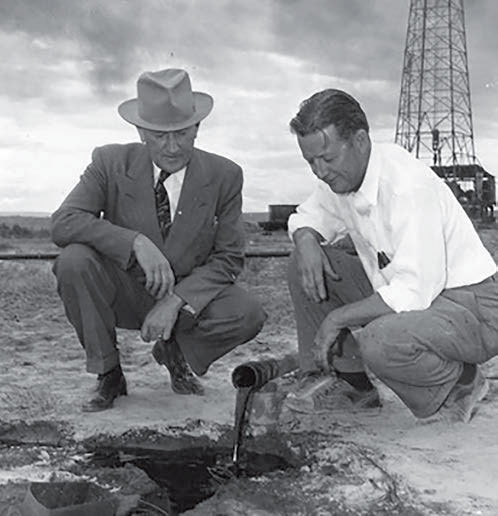
J.L. "Mike" Dougan, left, watches oil flow from his historic 1948 Ashley Valley No. 1 well about 10 miles southeast of Vernal. Photo courtesy of the Utah State Historical Society.
Perry commended Utah officials, research institutions and the private sector for their efforts to deliver energy more efficiently and in a more environmentally sound way. “I am delighted that Utah remains all-in on the ‘all of the above’ strategy,” he said.
Nationally, President Trump’s “all of the above” strategy has meant removing “draconian” regulations on energy produced by oil, gas and coal; “reviving, not reviling” nuclear energy; and supporting continued growth of renewable resources, he said.
“Instead of punishing fuels that produce emissions through regulation, we’re seeking to reduce those emissions through innovation, and by any measure — any measure — we’re succeeding,” Perry said.
Despite being the world’s top oil and gas producer, the U.S. also is leading the world in reducing energy-related carbon emissions. “You heard that correctly,” Perry said. “All too often, either people aren’t hearing or they don’t want to hear or they don’t believe it, but we have proved that we can make our energy cleaner without surrendering one single fuel, one bit of growth, one iota of opportunity.”
Herbert said Utah is working to meet the goals of energy consumers, who want energy that is reliable, sustainable, affordable and cleaner.
“It’s pretty hard to have a good and healthy economy if you don’t have energy. … With the complexity of energy, as you all know here, it’s very emotional for some people what we do, what we don’t do, and how we should do it or if we should do it,” Herbert said.
“All of those things are things that need to be addressed. And we ought not to be afraid of having a discussion and bring, as Secretary Perry has always taught us, a little common sense to the discussion, and see what is practical and what is realistic to actually accomplish.”