
This spring, the Golden Spike National Historic Site commemorates the 150th anniversary of the completion of the transcontinental railroad. The celebration provides a good excuse to take in all Northern Utah has to offer.
“All aboard!” was the call of the conductor to those boarding the passenger trains that crisscrossed the country for many years in the late 1800s and early 1900s.
But in the years following the Civil War, the words “all aboard” were also a call to explore a nation rapidly expanding westward. It was an invitation to the people of the land to expand their vision and fulfill their perceived destiny, to join in exploring a new country which spread out before them to the west. The United States was a vast country, little known but filled with promise for the future. Many held a vision of a land stretching from “sea to shining sea” and brimming with opportunity help people fulfill their biggest dreams.
Few things captured the spirit of that vision for the United States like the first continental railroad joining the country from Missouri in what was then the “Far West” with Sacramento in the largely still-mysterious state of California.
Prior to the completion of the railroad, a trip from New York to San Francisco could take six months and cost $1,000. By land it was an arduous journey fraught with challenge and danger. An alternative was a torturous voyage by sea around Cape Horn. But after the railroad came, the trip was reduced to just days and cost a much more affordable $150. In addition, the trip was far less dangerous and was accomplished in relative comfort compared to what people had previously experienced.
Although originally conceived in 1845, the Pacific Railroad Act wasn’t formally proposed until 1860 and signed into law by Abraham Lincoln in 1862. The Civil War delayed major construction on the line, but it’s amazing to realize that the linking of East and West by rail occurred just four years after Lincoln’s assassination.
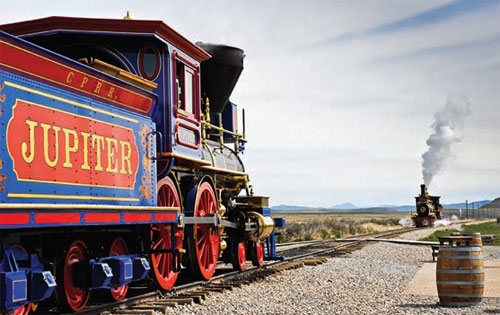 This summer an “all aboard” invitation is again being issued to people in Utah to remember the past and explore the future for themselves by commemorating this significant event in our nation’s history.
On May 10, 1869, the final rails linking the railroads coming from the East and from the West met at Promontory Summit on the north end of the Great Salt Lake where a commemoratory Golden Spike was driven by financier Leland Sanford to mark the occasion.
To honor the original Golden Spike ceremony, Utah’s Transcontinental Railroad 150th Celebration Commission was formed by the Utah State Legislature and Gov. Gary Herbert in 2017 to honor and commemorate that 1869 event. The Commission will celebrate the 150th anniversary of the “wedding of the rails” and the driving of the Golden Spike at Promontory Summit on the weekend of May 10-11. The Commission is also promoting many other commemorative events and activities that “inspire, unify, educate and advance the legacy of this historic moment.”
Events commemorating the driving of the Golden Spike include numerous celebrations being held throughout the state, from a re-enactment of the trains from East and West meeting at Promontory Point, to concerts by the Choir at Temple Square, the Utah Symphony and a special concert by Brian Stokes Mitchell and Megan Hilty. Other events include plays written to highlight the event, exhibits and special displays, as well as frontier villages reminiscent of the 1869 time period, parties and speakers.
In outlining the role of the Celebration Commission, Herbert called the completion of the railroad “one of the greatest accomplishments in the history of America and indeed the world. Even today the transcontinental railroad stands as a pinnacle of human achievement. With the completion of the railroad, Utah became the 'Crossroads of the West' and it remains even so today.”
“I hope these celebrations can again help unify our country and serve as inspiration for our next great American pursuit,” Herbert concluded.
Major events planned for the 150th anniversary of the driving of the Golden Spike will take place May 10-12 at the Golden Spike National Historic Site, which is located 32 miles west of Brigham City via Utah Highway 83. Tickets are required and can be obtained through the Spike 150 website, spike150.org. The site will be open from 8 a.m. to 7 p.m. for the three days of the event. Park hours typically are 9 a.m. to 5 p.m. (except Thanksgiving, Christmas and New Year’s Day).
The Golden Spike National Historic Site draws nearly 60,000 people per year and has permanent exhibits about the railroad and its history as well as video presentations and frequent special events and re-enactments.
Events at the historic site on May 10 include the arrival of Jupiter and No. 119 replica steam engines; remarks by dignitaries from Congress, the National Park Service and the state of Utah; and a keynote address by renowned presidential scholar Jon Meacham, who will share his historical perspective on the importance of the completion of the transcontinental railroad
It is expected that the May 10 Golden Spike commemoration may draw between 10,000 and 20,000 people and greatly impact the area economy.
In addition to the human participants, three of the original “spikes” will also be in Utah this summer. The most famous of the spikes is the golden one normally housed at the Cantor Arts Center at Stanford University. But that spike, together with two others, one of silver from Nevada and one of iron and copper forged in Arizona and originally created for the 1869 ceremony, will be re-united and on display to the public at the Utah Museum of Fine Art in an exhibit titled “The Race to Promontory: The Transcontinental Railroad and the American West.”
Three other exhibits highlighting the relationship of Utah to the railroad and the railroad to Utah are on display at the Utah State Capitol Building.
“Tracing the Path,” a photographic journey through time tracing the historic race across the West, will be presented by the Chinese Railroad Workers Descendants Association. Perhaps as many as 14,000 Chinese immigrants labored on the west Central Pacific line. Construction through the Sierra Nevada Mountains was the most difficult stretch of the railroad line and many lost their lives during construction. Following the completion of the railroad, many Chinese continued to work for the railroad, some for 30 or 40 years.
Along with the Chinese, many Civil War veterans and Irish immigrants help move the two ends of the rail line. Once the construction neared Utah, Brigham Young recruited local members of The Church of Jesus Christ of Latter-day Saints to assist. Commemorating the role of these railroad workers is also important, according to Herbert.
“They accomplished a remarkable engineering and construction feat and we will give them the recognition they so rightfully deserve,” the governor said.
The second exhibit is titled “A World Transformed: The Transcontinental Railroad and Utah.” It is a joint endeavor of the Merrill-Cazier Library at Utah State University and the Utah Division of State History. It tells the story of the railroad in pictures, diary entries and artifacts. This exhibit will travel to several other sites this year.
 “The impact that the transcontinental railroad had on the history of Utah cannot be underestimated,” according to Todd Welch, associate dean of special collections at USU.
“Death, Taxes and an Unexpected Windfall” is the third Capitol Building exhibit and tells the interesting tale of how the estate of a railroad mogul, Union Pacific’s E.H. Harriman, transformed the art and architecture of the Utah State Capitol Building. It is sponsored by the Utah Department of Heritage and the Utah Capitol Commission.
For a complete review of statewide events commemorating the 150th anniversary of the Golden Spike, go to spike150.org.
The 150th anniversary ceremony at the Golden Spike is only a small sample of the interesting, educational and fun things to do this summer in the northern end of the state. Other popular activities and sites to visit include (but are certainly not limited to):
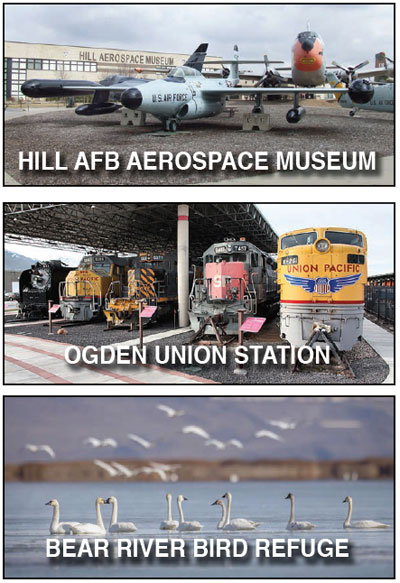
Hill Aerospace Museum
The museum has large display (70-plus) of aircraft, from a Wright brothers replica to the B-1 Bomber. Highlights include the B-17 Flying Fortress, the SR-71C Blackbird, the A-10 Thunderbolt II and one of the first operational F-16 Fighting Falcons which Hill Air Force Base has been associated with. The museum attracts over 265,000 visitors annually. Admission is free (contributions appreciated). The museum is open Monday through Saturday except Thanksgiving, Christmas Eve, Christmas Day and New Year’s Day, from 9 a.m. to 4:30 p.m.
The museum also supports on-going research and educational programs.
Ogden’s Union Station
It was once said “You can’t get anywhere without going through Ogden!” In its heyday, nearly 120 trains per day would stop at Ogden’s Union Station carrying business and leisure travelers alike. Union Station has preserved the history of the era and the area and captured many stories of the station and the past. Included is the Utah State Railroad Museum, the John M. Browning Firearms Museum, the Browning-Kimball Classic Car Museum and the Utah State Cowboy and Western Heritage Museum.
 Bear River Migratory Bird Refuge
In the 1920s, due to the loss of marshes and huge bird die-offs from botulism, local individuals and organizations urged Congress to protect this valuable resource in Northern Utah. In 1928 the Bear River Migratory Bird Refuge was created. It is now one of over 550 refuges in the National Wildlife Refuge System. Of the more than 200 bird species that use the refuge, 67 species nest there. The refuge is an excellent place to observe wildlife along a 12-mile auto tour route. There are also 1 1/2 miles of trails around the world-class Wildlife Education Center located one-quarter mile west of I-15 at Exit 363.
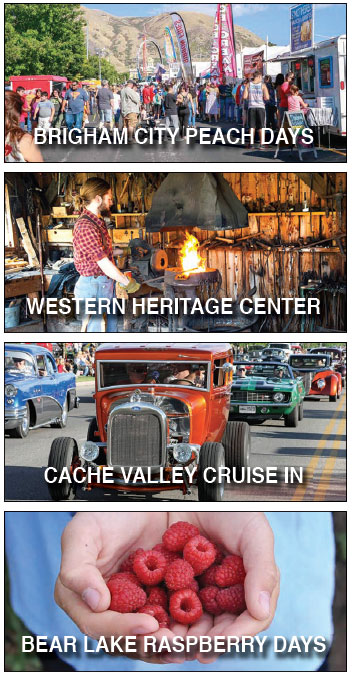
Brigham City Peach Days
Peach Days began in 1904 as an event to celebrate a “day off” during the peach harvest. The annual event attracts approximately 35,000 people with a variety of events. This year’s event is Sept. 6-7.
Western Heritage Center
Located about 20 minutes from Brigham City on Highway 89 in Wellsville, the center shows pioneer life in the Old West through interactive exhibits, period buildings and farm implements and seasonal festivals. Not to be missed for the kids are “Baby Animal Days,” April 3-6, 10 a.m. to 6 p.m.
Logan “Cruise In”
The 37th Cache Valley Cruise In will take place July 4-6 in Logan. It is the largest three-day car show in Utah, with over 800 cars. There is also an indoor area showing specialty cars. Activities include a “show and shine” sock hop, concert and Main Street Cruise of classic cars. Tickets are required for some events.
Bear Lake Raspberry Days
Raspberry Days at Bear Lake are Aug. 1-3. Events include arts and crafts shows, a parade, the Laketown Rodeo, live concerts, a 5K run, a pancake breakfast, a golf tournament and fireworks.