
Recursion Pharmaceuticals is emphasizing the “tech” in “biotech.”
The Salt Lake City-based company is at the forefront of trying new ways to leverage artificial intelligence, automation and experimental biology to produce data that can eventually lead to the creation of medicines to treat diseases.
“Our ambition is to build the first truly technology-enabled pharmaceutical company,” Tina Larson, Recursion’s president and chief operating officer, told the Governor’s Office of Economic Development (GOED) board during a briefing at the board’s October meeting.
“We are very squarely the leader in the space for companies that produce their own data,” she said. While several drug discovery companies are using artificial intelligence “now that this is a thing,” she said, most have not had the time nor money to create their own data, instead relying upon data already available. “We are far ahead of companies in terms of generating our own data.”
Recursion’s work rests on a belief that the human limits of understanding biology have been reached. Using robots to add and remove liquids and add dyes to experiment plates, its technology finds ways to mimic disease in cells, changes genes and finds ways to model diseases. Then the company’s large library of potential medicines enters the process as the company trains the machines to know the difference between diseased and healthy cells and determine what compounds can turn a diseased cell into a healthy state without having toxic side effects.
Larson likened the process to Google Maps, a technology offering various paths for a person to reach a destination. Recursion maps cells.
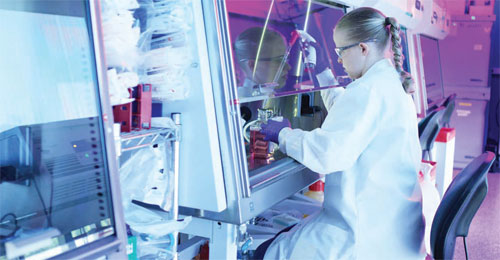
A Recursion Pharmaceuticals employee works at the company’s 100,000-square-foot lab and office space at The Gateway in Salt Lake City. The company, founded in 2013, is using technology to boost the speed and lower the costs of getting potential drug candidates to the point of human clinical trials.
“That’s what we’re looking to do with biology, to build this map using these images of biology, and then ask questions that can route us, like what kind of chemical compounds can be drugs that route us from ‘diseased’ to ‘healthy’?” she said.
Recursion currently is conducting 400,000 experiments each week and is scaling to 2 million per week. Founded in 2013, it has produced over 3.5 petabytes of data — a petabyte being 1,000 terabytes or 1 million gigabytes.
All of that computational work is designed to streamline the process of getting a potential medicine to the point of human clinical trials. Larson said the pharmaceutical industry’s productivity has been falling and is “is absolutely abysmal.” The cost of bringing a new medicine to market typically costs $2.6 billion for research and development, which typically takes about five years, and 88 percent of potential medicines fail during clinical trials.
By applying the efficiencies of data science to drug discovery, Recursion hopes to speed the R&D process and quickly weed out drug candidates with a poor likelihood of addressing disease, while at the same time increasing the speed and reducing the costs of getting successful drugs to market.
“Our opportunity is to create a truly tech-enabled pharmaceutical company that particularly can increase this [drug] success rate by finding better medicines — kind of the tech concept of ‘fail fast, fail early,’” Larson said. “It takes, on average, 15 years to bring one product to market, so what we want to do is to bring that opportunity to fail faster and earlier to affect this success rate.”
Armed with more than $200 million in fundraising, including $121 million raised in July, and 100,000 square feet of lab and office space at The Gateway, Recursion already has two clinical trials underway that are focused on relatively small patient populations with rare genetic diseases. But it plans to expand its portfolio in the future.
“At the end of the day, [with] all this fancy technology, the point here is to develop meaningful new medicines for patients,” Larson said. “And it’s really important that we don’t miss sight of why we’re doing this. It’s important particularly because I think there’s a lot of negative stereotypes of tech companies trying to get into healthcare … and maybe pushing too fast and too far and potentially putting patients at harm.”
Larson believes Recursion and its staff of 160 “Recursionauts” are exploring new frontiers.
“We consider ourselves an anchor for the biotechnology industry in Utah,” Larson said, noting that Utah already has companies that serve as anchors in medical devices, technology, diagnostics and health IT. “But really the state does not have a robust biotechnology and pharmaceutical industry, and so we hope to be really the center of anchoring this aspect of ‘life science meets tech.’”