

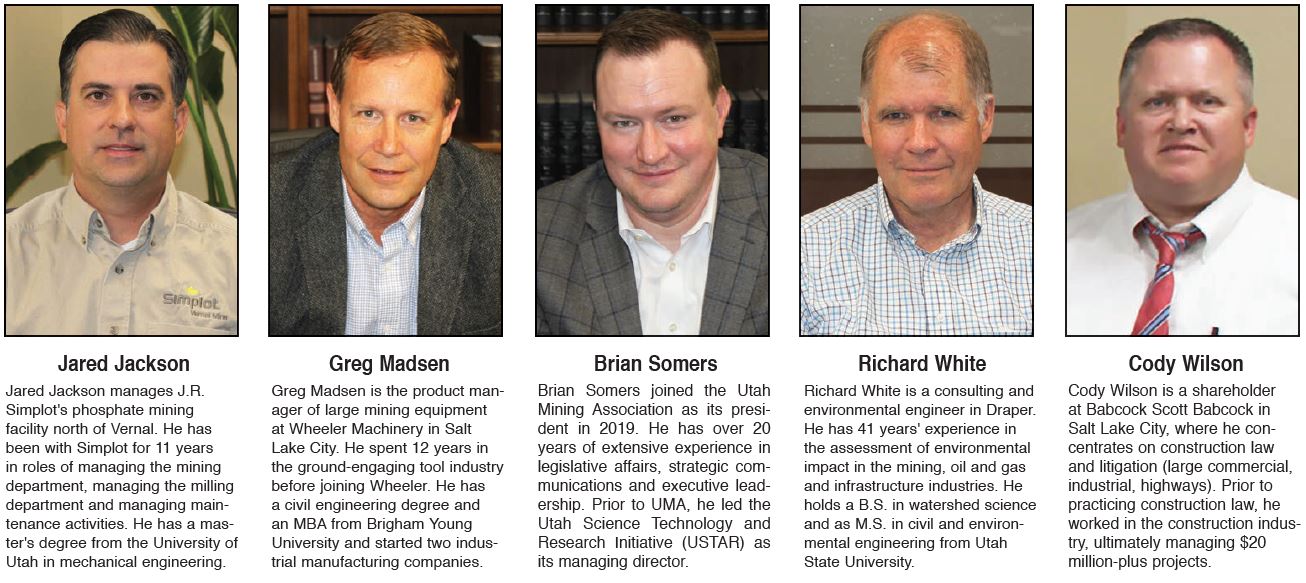
PARTICIPANTS: Bradley Babcock, Cementation AG; Brian Babcock, Babcock Scott & Babcock PC; Bob Babcock, Babcock Scott & Babcock PC; Lennie Boteilho, Ames Construction; Jed Iverson, Brahma Group; Jared Jackson, J.R. Simplot Co.; Greg Madsen, Wheeler Machinery; Brian Somers, Utah Mining Association; Richard White, EarthFax Engineering Group; Cody Wilson, Babcock Scott & Babcock PC
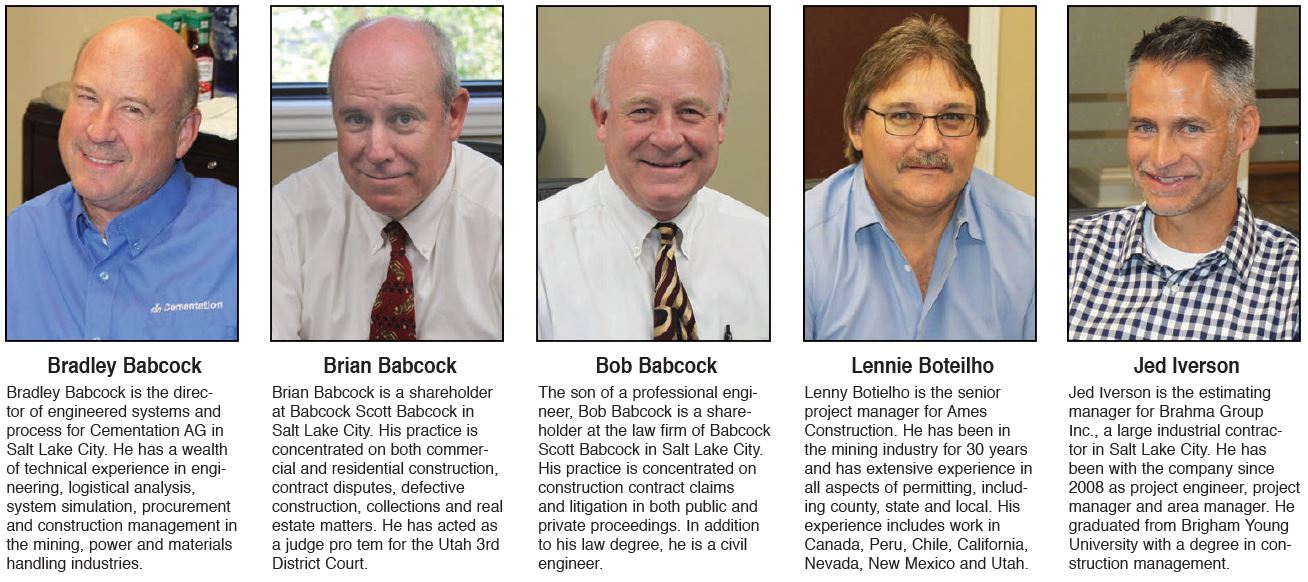
In this roundtable discussion, members of the mining industry discuss various topics regarding the current state of the industry, such as: education of the general public, the government and students; technology; labor shortages; tariffs; commodity pricing; and industry stability.
BOB BABCOCK: Brian, as president of the Utah Mining Association (UMA), do you have any comments on the industry as a whole in Utah?
BRIAN SOMERS: I think the industry in Utah has some great advantages. We have a very diverse mining industry — meaning the mining sector is not wholly dependent on one type of mineral or resource. Also, there is a lot of historical support for mining in the state, especially in some of the rural communities where mining has been the bedrock of their economic development for a number of years. Even in Salt Lake, the Kennecott operation is, by and large, accepted. Overall, I think Utah is a mining-friendly state. As to the health of the industry, I think it is healthy and growing. It is not growing as quickly as the tech sector or other parts of the economy, but it is growing. That is what’s important.
BOB BABCOCK: As you all know, along the Wasatch Front, the aggregate mining industry receives a lot of political pressure from the “not-in-my-backyard” concept. But the rural areas of the state are a lot more accepting and are actually happy about the employment opportunities it brings. What can the industry do to help get a different response along the Wasatch Front?
BRADLEY BABCOCK: I think it’s truly important for the public to be educated. With the aid of the Utah Mining Association, I think the state can accomplish — or at least help — accomplish that. It is important for the public to understand that you can’t have a Tesla without copper from Kennecott or a lithium mine. People want new highways and they want their houses built on the side of a hill. Well, you can’t get that without Geneva Rock taking the aggregate out of the mountainside.
JARED JACKSON: We need to do a better job of that as an industry. There are those who oppose mining and they are putting a lot of effort into communicating that to the public. We need to be better at showing the relation between the products that we enjoy and the mining industry. If you want a car, a cell phone or a computer, you need a mine to be able to supply that. More than that, we also need to show the benefits the industry brings to the economy and our local and state communities.
GREG MADSEN: The mining industry has a reputation for being unsafe and environmentally wrong. I think a lot of that is a legacy reputation. Frankly, the industry deserved and earned that reputation. But, that is no longer the case. Now, some mines have recently gone 1 million man-hours without a lost-time accident. That is 12 working lifetimes. Twenty years ago, I would have thought that was impossible. And on the environmental side, I don’t know a group of people that are more environmentally conscious than miners. We need to do a better job communicating these safety and environmental advances to the general public so we can change our reputation. For instance, the UMA has a fourth-grade education program. In a PowerPoint presentation, they try to educate students about things that most people would never think about, such as: If it’s not grown, it’s mined. There are 56 minerals in an iPhone. (They show) before and after photographs of mining clean-ups and they also share a list of occupations that exist in the mining industry.
BRADLEY BABCOCK: I think this is a great starting point. We ought to be repeating these programs in the junior highs where they have career days and at high school career days as well. We need to keep reminding them what is out there.
BRIAN SOMERS: One thing the UMA is trying to develop now is a way of informing high school students of the diversity of career options that are available in the mining field. I think that mining is not always at the forefront of high school students’ minds. And we, as an industry, need to do a better job of helping people understand that the mining field holds really great job opportunities.
BOB BABCOCK: We have talked about the importance of the educating the public. What about the education of the government?
BRADLEY BABCOCK: I think it is very important for the government to be informed before any crisis hits. That way, when their constituents come knocking at their door demanding that they take action, they will be more inclined to make a less-rash and more-informed decision.
JARED JACKSON: I think a lot of it is reminding people — government included — that we have to mine where the minerals and resources are. We are at the mercy of the land. Kennecott is not on the west of Salt Lake for our convenience. It is there because the resources are there. While many people may wish that all the resources were out in the middle of the desert away from the population, that’s just not the case.
RICHARD WHITE: It is interesting, because once you get down into Carbon and Emery counties where the economy has been coal from Day One, the public and the local governments are very educated in, and supportive of, the mining industry. If a new road needs to be built for one of the mines, the county will build it. Of course, it is built with the mine’s money. But it is now a county road.
CODY WILSON: How has technology impacted the industry?
GREG MADSEN: A lot of people think that there isn’t a lot of technology or education in mining, which is increasingly less true. It is high tech. And we need people with state-of-the-art skills in computers, robotics, automation, engineering and environmental areas. One of our challenges is the increasing technology and people who are able to deal with the increasing technology. For example, diesel mechanic jobs, for the most part, require a four-year degree. It’s just not the way it used to be. It’s high tech. It’s computer science.
BRIAN SOMERS: In many cases it’s the mining, industrial and agricultural industries that are actually making the advancements, which eventually get rolled into the consumer side with cars and other things. Today it is a much different and much more sophisticated industry. That has been reflected in the fact that not only are there increased job opportunities, but there is also a much-improved safety record and a much-improved environmental record because of the advances that are being made by implementing technology in the mining space.
RICHARD WHITE: You can still get a job right out of high school, but you’re going to be a lot better off if you at least get some technical education. That way you have some background knowledge in the technology being used in the industry. You are able to get into some pretty fascinating technology. For example, look at the GPS units that are mounted on something as simple as a dozer. Those satellites are telling that dozer what to do and the operator is just keeping if from going over the cliff.
BOB BABCOCK: Switching gears a little, what is the industry seeing as far as labor-related challenges?
GREG MADSEN: We are starving for qualified technicians. It is a challenge to attract young people and help them recognize mining as an occupation that they might be interested in. Referring back to the discussion on educating the public, we need to educate the public on the amount of high-paying jobs within the mining industry.
RICHARD WHITE: We have that same challenge in the coal industry. There is a lot of gray hair in the industry that is retiring. Mines are having a hard time replacing all of the engineers and managers that are retiring.
JED IVERSON: We are not just having a hard time replacing engineers who are retiring, but recruiting and keeping craftsmen. I think this generation — the millennials — are choosing different paths. But, with how well the industry is doing, we need the millennials. What the Brahma Group has done to find and train people, is we have set up recruiting and training centers, one in Salt Lake and another in Page, Arizona. We make sure they are MSHA- and Kennecott-trained so we can put them to work. In the last month, we have trained 200 people at these centers.
JARED JACKSON: You have to get creative — like what Brahma Group is doing — and form some of your own training programs. At Simplot, we cannot find enough diesel technicians. So, we partnered with Wheeler Equipment and our local technical college and put together an internship program. We take diesel technician students and give them some experience at the mine on mining equipment and at the Wheeler shop in Vernal — all in an effort to get them interested in working with mining equipment.
BOB BABCOCK: What about tech schools? Are they keeping up with the demand?
BRADLEY BABCOCK: I think the tech schools are trying. The problem is, you get kids that are coming out of school that have the mindset of, “My grandfather and my father all worked in the mines. I don’t want to work in the mines.” And the fathers are telling them, “You don’t want to work in the mines.”
RICHARD WHITE: It is tough because the grandpas and dads both worked under conditions that were pretty tough. They don’t realize that safety protocols have advanced substantially. Technology has advanced and overall things are different now. It takes a pretty forward-thinking kid to say, “I want to be in this industry.” Universities and schools are building programs to teach them — if they can just convince the kids to get into those programs.
BRIAN SOMERS: The state has done a lot of things on workforce development. They have various Pathways programs now. I think the diesel mechanic Pathway is the only one that is directly targeted at the mining industry. Why don’t we have an electrician Pathway? Why don’t we have some of these other Pathways so that kids can understand that mining is not just going underground or being an equipment operator? I think there is an opportunity, through these Pathway programs, for government to do a better job and work more collaboratively with the industry to help with workforce development.
GREG MADSEN: Even with the success of the Pathways program, we are still dying for diesel mechanics. We are unable to fulfill our current demand or come anywhere close to it.
BRIAN BABCOCK: With that, this question is specifically targeted at the construction contractors in the room. How are your companies dealing with labor issues? You are broad enough to be able to move people back and forth to deal with all the fluidity in the mining markets. How do you market that to your employees and potential future employees?
LENNIE BOTEILHO: Ames Construction has spent a lot of time going to colleges and universities and working with their internship programs in an attempt to educate students on what is out there in the mining world. We are trying to inform them that the mining industry is a lot more than just running equipment. It goes all the way to the management level. This year we were able to get two interns in a mining program. We made 17 offers and got two. We have gone a step further and started buying software and giving it to the universities to teach the students how to use it, since the universities won’t buy it themselves. We have bought Primavera, AutoCAD, AGTEK, etc. But, universities are mostly stuck on their curriculum and it is hard to get them to change it, although we have had a couple universities adapt some things.
RICHARD WHITE: Another difficult aspect is that graduates may understand the theoretical background — which you have to have — but they don’t understand how it practically applies or how to implement it in real-world situations. The trade schools do a much better job at practical applications, but the universities still stay pretty theoretical.
BRADLEY BABCOCK: That is one of the problems. I taught at the university level for two years. At the university level, they expect you to publish or perish — not to throw any stones at the publishing industry. I think that shifts the focus from teaching to publishing. But if the industry could put people in as adjunct professors, you wouldn’t have the same restrictions: publish or perish. That way, the students would likely be taught a much more practical understanding along with the traditional theoretical understanding.
LENNIE BOTEILHO: The mining program in Nevada has been able to work with various mining companies to have their managers and more-senior employees teach one or two days a week in a couple of the mining classes. Their students are coming out with a better understanding. Yes, you have to know the formulas and all of that, but students also need a little of the hands-on feeling as well. Montana Tech is a great example. They produced a lot of good mining engineers. They had people teaching the programs that used to be miners. Now, it has transitioned away from that. So, now, their program has kind of struggled to fill their classes the last few years.
GREG MADSEN: It is interesting, this talk about technology and the lack of trained, educated and qualified people is the same conversation that is being had in Australia, or in the tar sands of Canada or in the copper mines of Peru and Chile. It is a global issue. It doesn’t matter where it is in the world. If there is mining, they are talking about lack of trained, educated, qualified employees. So, the message is: “If you want to see the world, if you want to work and live in Australia, Canada or South America, mining is a great way to do it.”
RICHARD WHITE: I think that is part of the problem, too. If you have grown up along the Wasatch Front, and that is where your family is, it is where you want to stay. Now, if they are single, they may be more inclined to move out of the country. Then it is easier since you aren’t moving a family around. So, if they are a diesel mechanic, they are more likely to say, “Well, if I’m going to be a diesel mechanic, I’m going to be a diesel mechanic at a trucking company because I can stay here.”
BRIAN SOMERS: I think that is part of the education process, too. There are definitely jobs that require transplanting around the world. But, there are other jobs in the mining industry that absolutely don’t. Look around the room. You all are examples of that. You have been here for a long time, making your living in the mining industry.
LENNIE BOTEILHO: I think it’s difficult to get people to travel. It doesn’t matter if it is the mining or the construction side at this point. We struggle with that. I get a call from a client asking for our help in South America. Then I spend weeks trying to put a team together and I might find one or two people who want to go. It is just hard to get people to get up and go now. You can offer to pay them a lot of money and they still won’t go.
BOB BABCOCK: Has anyone made any inroads in the immigrant population? Typically, they are a little more motivated and willing.
BRADLEY BABCOCK: I think it would be interesting to put some education at the border and integrate immigrants into skills that are needed and put them into locations that are in need of those services and skills. The industry could help solve some of the issues at the border, if we could somehow educate and place immigrants into jobs.
RICHARD WHITE: I am seeing professional level immigrants in the mining industry. I have hired guys from Ghana, a woman from China, and a guy from Iraq. They all came in with Ph.D.’s. I am not seeing a lot on the technical level when I am around the mines. I don’t know if that’s just because they are not available or what.
RICHARD WHITE: Think about if you had a technical training school in El Paso where you bring immigrants in for two years. You set up requirements for them and promise a green card upon completion of the program. There has to been a way to figure this sort of thing out. There is a massive workforce available. And, we have the need.
GREG MADSEN: There is a great example of that in Perth, Australia. WesTrac, a Caterpillar dealer, has brought in 900 people into their three-year technical training program — most from South Africa. They have language classes, computer skills, everything. That is what it has taken WesTrac to get enough technicians on its staff.
CODY WILSON: We have spent a lot of time talking about labor and education, which I think is an indication of where the industry’s biggest challenges may be. Let’s switch gears and talk about commodity prices and government regulations.
GREG MADSEN: Coal is struggling. Not just in the state, but globally. With the price and environmental superiority of natural gas, coal is struggling. We have copper mines that are mothballed — or really — on care and maintenance. So, commodity price increases would really help that. And we have a huge iron ore deposit down in Iron County that has been mined in the past that is not being currently mined. From a political perspective, things look a lot more stable and I think the overall outlook for the industry is much brighter than it has been in the past. There is a lot more long-term confidence.
JED IVERSON: I think with the upcoming election year, there is certainly the potential that things will slow down, but we still feel really confident. We feel like it is going to continue to grow.
BRIAN SOMERS: I think this brings up the larger point of the uncertainty the industry faces from government regulation, especially on the federal side. When the federal government has policies that lead to the artificial demise of an industry, it is not just the mines that are affected. It’s also the companies supporting the operations, as well. The policymakers need to understand that it is not only a copper mine or a coal mine that is being mothballed, but truckers, construction workers, engineers, lawyers and other supporting roles that are being put out of work. Beyond that, the state and local governments are losing income through mineral revenues, property taxes, income taxes, etc., etc.
BRIAN BABCOCK: How do you get stability in the mining industry? Is there a way, or is it more of a pipe dream?
BRIAN SOMERS: It is very difficult to have stability when there are so many different levers that can be pulled to make life really problematic for the industry. But, I think if you are electing people that understand the importance of the mining industry, that could help. I do think that the answer to this question ties into what we have already talked about. And that is informing the general public — the people that are voting policymakers into office — of the importance of our industry.
RICHARD WHITE: Unless you’re Materion, which mines the largest beryllium deposit in the world, then you are subject to global economic forces that you cannot control.
BRIAN SOMERS: Yes, that and you are also in direct competition with other countries that are not playing fair in the global markets. For instance, I don’t think that Kennecott is less efficient in extracting some of their rare earths than China. I think they are far more efficient. But, in China, there is a lack of environment and labor regulations, which Kennecott has to abide by.
BRIAN BABCOCK: What about tariffs then? How do you think tariffs play into trying to help the rest of the world play fair?
BRADLEY BABCOCK: That’s a tough one. It costs the consumer a lot of money when you put tariffs in place. But, obviously, it’s a negotiating tool that is being used to play tough in the hope that others come to the table and you can pull back and get back to business. It is a dicey situation.
JARED JACKSON: It is kind of a two-edged sword. For instance, take the phosphate industry as an example. We would love to have tariffs on those countries that are importing phosphate into the U.S. that are not on a level playing field, so to speak. They do not have to abide by the same environmental, safety and labor regulations. On the other side, we also would like to export our products to these same countries, as well. I think people are just anxious to see how the tariffs will play out. There could be some benefits to the industry. But there also could be some aspects that could negatively impact the mining industry.
CODY WILSON: How do we encourage the industry to put more people in the political arena? Or, how do we encourage people from the industry to become more politically active?
BRADLEY BABCOCK: I think that our industry could be truly benefitted by having professionals from our industry being voices of reasons in the state legislature.
BRIAN SOMERS: I think the pressure that has come from environmental organizations has got a lot of folks in the industry wanting to put their heads down and go about their business. But, we’re in a world where you can’t do that. You have to be participating in the political process. You need to be willing to pick up the phone and let them know that the bill they are contemplating is going to cause problems for the industry. We have got to make sure we have a seat at the table to keep the state mining-friendly long term.
GREG MADSEN: We are really fortunate in Utah to have Gary Herbert and Rob Bishop, who, I think, are both very supportive of the mining industry. We are a mining-friendly state at this point. Maybe there needs to be a lot more thought going into what we need to do to keep it that way.
BRIAN BABCOCK: Any comments on infrastructure or transportation?
GREG MADSEN: I would mention two things about that. The first is access to West Coast ports can be huge for coal and iron ore. The other is improving transportation of petroleum and bitumen out of the Uintah Basin. That could be economically and significantly big for mining here as well.
BRADLEY BABCOCK: The access to West Coast ports is huge. Currently, California does not want any coal shipped out of their ports. There is a big court battle in California about this right now. We have been trying to get a port in Washington that we can ship coal out of. It has been so difficult that there has been talk of going down through Texas since there is, in essence, a blockade on the West Coast that won’t let us export any coal. In the past, we were able to export coal through the Port of L.A., but that has since been shut down.
RICHARD WHITE: That is a real problem. The Emery mine was going to ship a million tons of coal each year to China. Then when the Long Beach port shut down, the mine was unable to do that. Nobody could ship off the West Coast. It is a real problem. Since it is a political issue, it is going to remain a real problem for a long time.
BRIAN SOMERS: This is where the state is still involved in trying to get an export terminal. The Governor’s Office of Energy Development is in that. They are looking at options in Mexico and elsewhere. I think this goes back to the discussion of making sure we are electing people that understand the needs of the industry and the opportunities that are available — you know — understanding the export markets, among other things.
BRIAN BABCOCK: In closing, what would you like the readers of The Enterprise to know about the mining industry?
JED IVERSON: We are optimistic about the future. The reason it is difficult to find employees is because everyone is so busy. I think that is a good problem to have. We are hiring a lot of people into high-paying jobs. And, it is a good industry.
GREG MADSEN: Mining makes modern life possible. It is absolutely critical to the economic stability and political security of the country. It is also an industry that is plagued, to a point, by an ancient history of being unsafe and environmentally unfriendly or unclean. But that was the past. It is neither the present, nor the future. Lastly, it is a great industry to work in.
JARED JACKSON: I would like to get the public thinking, in general, what would happen if the mining industry went away. You would not be able to have a car, a cell phone, a computer or supply food to our population. I would also like to refer people to the UMA to learn more about the mining industry's importance for the state of Utah. Go to their website, www.utahmining.org. You can find a lot of great information there about the benefits that mining provides our state.
BRIAN SOMERS: $80,000 is the average salary in the mining industry. That is significantly higher than the state average. In many rural counties, the mining industry is critical for keeping people employed in family-sustaining jobs.
RICHARD WHITE: It is not just the salaries the miners are being paid, but the grocery store and hardware store, along with all their employees, are there because the mine is there.
LENNIE BOTEILHO: If the mine shuts down, think about how many other businesses go out of business, as well. There’s a lot of supporting businesses that support one mining operation. And, typically, those jobs pay pretty well, too.