
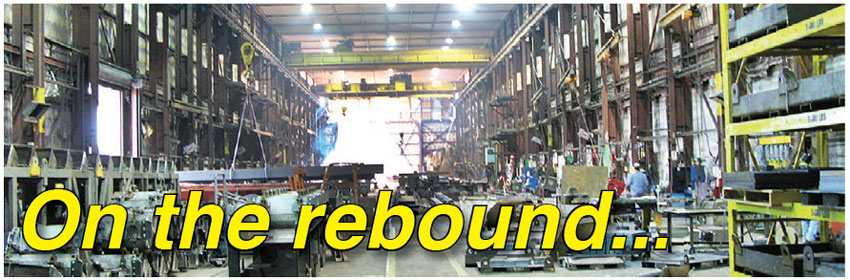
 Utah’s manufacturing industry consists of approximately 3,500 companies that provide 125,000 jobs throughout the state. The output of the manufacturing industry represents more than 14 percent of the gross state product, whereas it accounts for only 9 percent of the state’s employment. Almost 80 percent of the 3,500 Utah manufacturers employ 20 or fewer employees and, thus, these small businesses form the backbone of the Utah manufacturing industry.
Reports about the manufacturing industry generally focus on a decline of the number of jobs, largely due to manufacturers off-shoring production overseas and robots replacing production workers. However, the Utah manufacturing industry has experienced an upward trend over the past years. Since 2010, manufacturing employment has grown between 1.5 percent and 2.8 percent per year, adding more than 15,000 jobs between 2010 and 2016, according to data from the Bureau of Labor Statistics.
Manufacturing jobs also contribute to societal prosperity in Utah, as the average monthly manufacturing salary in Utah in 2015 was $4,533, whereas the statewide average monthly wages across all industries was $3,621, according to data from the Utah Department of Workforce Services. Thus, continuing the trend of bringing manufacturing jobs back to Utah is desirable and it is a realistic goal. Three key points can accelerate accomplishing it:
First, manufacturers can drive production back to the United States as global manufacturing economics start to change. The cost advantage of off-shoring production has steadily declined for certain categories of products.
Manufacturers also report inherent problems with an off-shored supply chain, such as quality control, increased lead times, reverse engineering, stolen intellectual property and high freight costs, which are difficult to address.
Additionally, re-shoring, i.e., bringing production back to the United States, offers distinct advantages. It allows for decreasing product development cycle times, which in turn enables flexibility and a fast response time to customer and market demands. The Boston Consulting Group reports that the shifting economics of global manufacturing no longer justify off-shoring many products intended for the North American market. Some manufacturers are exploring the possibility or are already moving their production back to the United States. The nonprofit Reshoring Initiative documented that since the manufacturing employment low of September 2010, almost 250,000 manufacturing jobs have been brought back to the United States.
Today the number of manufacturing jobs returning to the United States is on par or exceeds slightly the manufacturing jobs leaving the United States. The Reshoring Initiative reports that the main reasons manufacturers cite for re-shoring their production are government incentives, availability of skilled workforce, proximity to customers and brand concerns.
Second, manufacturers need to embrace automation and robotics. Robots will replace manual labor jobs in the United States and around the world. However, they also create new high-skilled, high-paying manufacturing jobs including programmers, maintenance operators, quality and safety personnel and high-tech technicians, to name only few. While disagreement exists about how many jobs robots will eliminate, it is important for manufacturers to actively make the shift to automation and not be left behind. This includes adapting their administrative and operational systems, plant layout, and staffing and staff training. Throughout this shift the workforce must be actively educated and engaged about the new benefits and career opportunities that automation brings.
Third, firms should provide training to adapt the manufacturing workforce to a changing industry. Manufacturing jobs today are not the same as they were yesterday, in part due to the increasing influence of robotics and automation. Hence, the technological revolution that is changing the manufacturing industry also changes the nature of its jobs. Manufacturing jobs are now well-paid, high-tech jobs that often require information technology and programming skills, maintenance of precision equipment and engineering of automation and robotics equipment. Training is needed to keep the manufacturing workforce abreast of these changes.
Adapting to a changing industry is often overwhelming for small and medium-sized manufacturers. Limited resources and staff require them to focus on today’s clients and filling next week’s orders, and no time is left to plan how their business will navigate the next five or 10 years. However, a forward-looking approach is critical for the long-term viability of a manufacturing business. This includes developing new products based on market demand, finding new markets in which to expand, using rigorous financial and operational planning tools, implementing the technology to support growth and implementing a company culture that supports these activities.
Hence, several organizations exist to support small and medium-sized manufacturers in all aspects of their business, specifically in helping them prepare for or respond to a changing industry. They include the Manufacturing Extension Partnership (MEP) centers and the Small Business Administration with its Small Business Development Centers. In Utah, these resources are crucial to support the growth of the manufacturing industry, specifically because the vast majority of the manufacturing industry consists of very small manufacturers (fewer than 20 employees).
Finally, continuing the growth of the manufacturing industry in Utah is also affected by the ultra-low unemployment in the state. This presents a major limitation to Utah’s manufacturers and further emphasizes the need for workforce training to increase participation and enable workers to gain marketable skills to work in the manufacturing industry. The Utah System of Technical Colleges is perhaps the largest provider of that market-driven technical education to meet the needs of Utah manufacturers. Also, the University of Utah MEP Center works with manufacturers on customized workforce training, in addition to any manufacturing or business-related project.
Utah is among the top states in the nation in terms of manufacturing employment growth. As Utah manufacturers keep focusing on 1. Re-shoring production to Utah, 2. Embracing robotics and automation, and 3. Adapting their workforce to the changing industry through specific training, it seems possible for the Utah manufacturing industry to continue that growth trajectory and maintain a thriving manufacturing industry that plays an important role in the state economy.
Bart Raeymaekers is a professor in the Department of Mechanical Engineering at the University of Utah and a co-founder of the Manufacturing Extension Partnership Center there.