
 Not long ago, at the end of a very hectic work week, I was driving home and my mind thought back on all the things that seemed to go wrong. Employee issues, late supplier deliveries, HVAC system downtime and an upcoming quality audit all ran through my head.
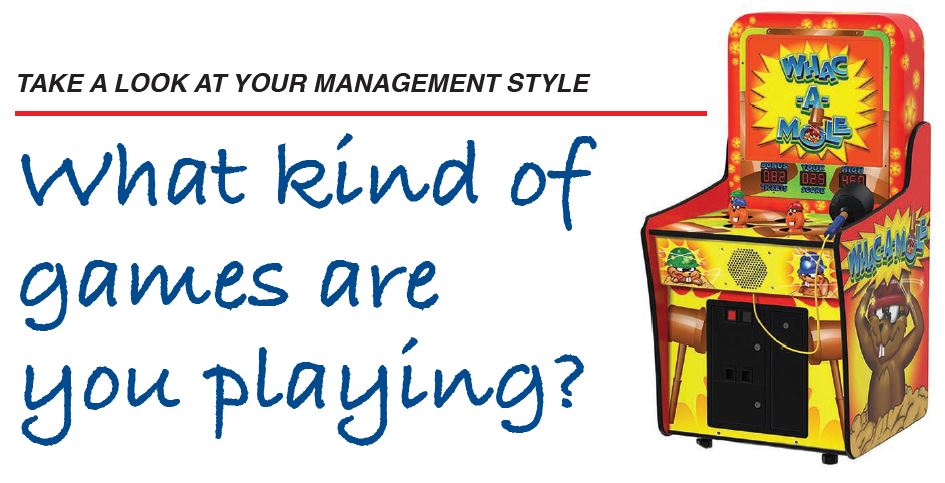
“I’m just putting out fires,” I thought. But no, I’ve never fought an actual fire so I couldn’t relate to it. Then I thought about a recent trip to a games arcade with some grandchildren, and the game I played with them that they really liked was Whac-A-Mole. You know the game. You have an oversized padded mallet in your hand and the heads of moles randomly pop up from five or so holes and you hit them to knock them back down and score points. They come at you rapidly and you never know from where they will pop up next.
“That’s it!” I exclaimed. I’m playing Whac-A-Mole at work. Problems and situations pop up from who knows where and I do my best to knock ’em down. Often the same problem pops back up but from a different hole. With that flash, I thought maybe I could present to the whole workforce what we were doing using this game to illustrate all that we needed to correct.
After dinner I went to my laptop and Googled “Whac-Mole” to find an image. I found more than that. I found renown author and business consultant Dr. Richard L. Williams had beat me to the punch. In a blog posted on the Center for Management & Organization Effectiveness website was Dr. Williams’ article, “Whac-A-Mole Management.” I consoled myself that great thinkers think alike.
In his article, Dr. Williams wrote: “‘Whac-A-Mole Management’ is a style of managing or leading others where a manager waits for something he or she believes to be wrong to happen, and 'whacks' the behavior with words and/or actions. This style has also been called 'Managing by Exception,' because the manager exclusively or primarily reacts to people who act in exception to his or her expectations.
“One of the most important things to remember when analyzing Whac-A-Mole Management is to note that the manager’s behavior is completely reactionary. No action is taken until the mole raises its head. The manager is not proactively trying to prevent things from happening, or trying to direct things to happen, or even making things happen, the manager’s behavior is a reaction to some other stimulus.
“In other words, Whack-A-Mole Management is non-strategic and totally tactical. Future problems, issues, trends, threats and opportunities will be a surprise, because the manager has his or her head down waiting for the next mole to raise its head.”
Oh, the games we play at work!
Here are some board games most of us are familiar with. See how these might apply to your work life or the approach your company takes to be a winner. I’ll bet you can come up with some of your own.
Monopoly. Become the biggest, richest person around. Buy up properties and collect rent from others. Be merciless. Drive others out of business. Depending on the rules you play by, make deals with other players, swap properties. But be careful: You might be the player to “Go to Jail!”
Chutes and Ladders. Derived from a 2,000-year-old game from India to teach morals, good deeds send you upwards closer to Nirvana and bad deeds the opposite. Luck or fate calls the shots with a roll of the dice. Sometimes we too roll the dice, hoping for a good outcome and counting on luck to make it so. Climbing the corporate ladder and being sent down a chute has never gone out of style. Even the most successful people and companies admit there is a bit of luck involved.
Chess. So many variants. A novice like me is slow and methodical, trying to think about every option but never seeing everything. Some tournaments use a time control called “blitz” where each player starts with a fixed amount of time to spend on their moves. Business decisions cannot always be slow. Competitors are playing the blitz game and so must you to remain competitive.
Stratego. Players are passionate as they employ strategy, tactics and good memory to capture the opponent’s flag or all their pieces while defending their own flag. Pieces representing soldiers of different ranks form an army. If your company or style is hierarchical and has an amazing organizational chart strictly adhered to, this may be your game.
Battleship. If you’re ready to go to war and annihilate your enemy/competitor by destroying its fleet, then this is your game. Casualties can be high on both sides, but if it the game is winning at all costs, this is the game to simulate. But you better be a good guesser.
Go Fish. This card game is especially good for supply chain managers! Need to find that component in stock? Go fish. Looking for a source to provide a critical service? Go fish.
Some readers of this recitation of good ol’ games may not find the comparisons very engaging. But the connection to games and applications in the real world is still valid. Now it has morphed into something more sophisticated — something we call “gamification.” In the workplace, it can boost productivity and engagement. Simply defined, it is the use of game elements in a non-gaming context to drive user engagement, loyalty and motivate the desired action. Games are one of the most powerful behavior motivators and anyone can enjoy games if given the right reason to do so.
States contributor Nina Angolovska in Forbes online, “There are many reasons why businesses should love gamification as much as users love games. As the retention and engagement crisis increases and the attention span constantly decreases, gamification can act as a remedy. When a brand needs to drive user engagement, motivate employees, increase sales, collect data, change a certain behavior or solve a business problem — well-structured gamification can act as a ‘magical wand’ in all cases.”
Paul Olsen has worked in manufacturing for four decades. He currently works as a consultant in the industry.