

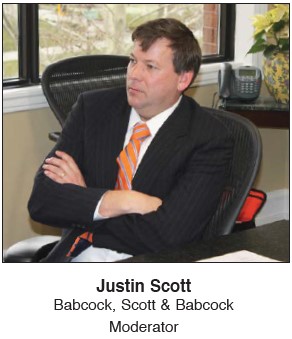
 Hosted by the Salt Lake City Law Firm of Babcock, Scott & Babcock
PARTICIPANTS
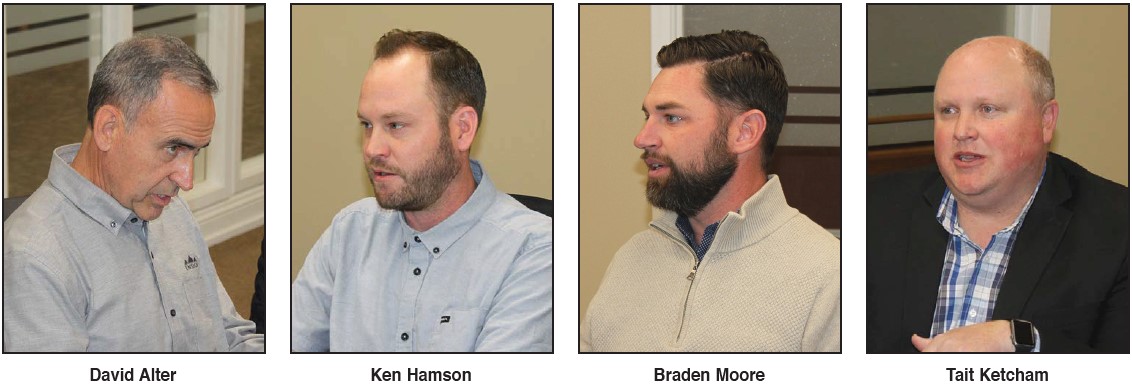
David Alter, President, Ensign Engineering and Land Surveying
Ken Hamson, Vice President, Whitaker Construction Co.
Braden Moore, Director of Project Development, Big-D Construction
Tait Ketchum, President, Dunn Associates
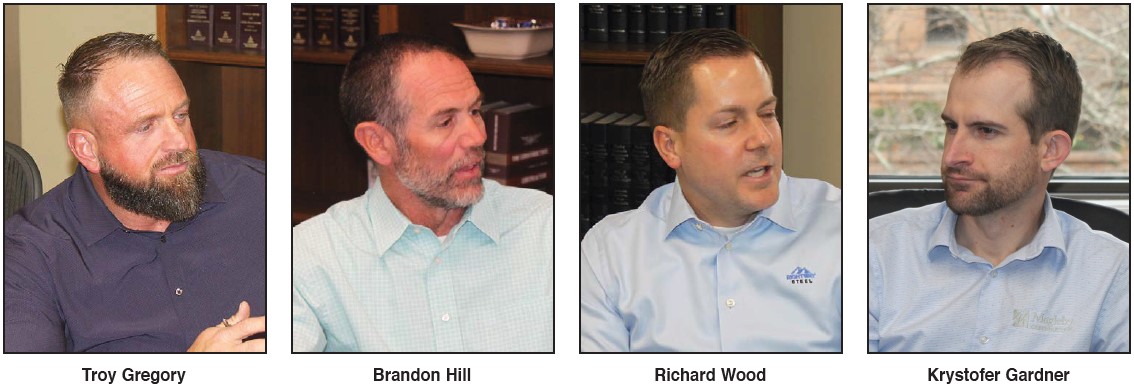
Troy Gregory, President & CEO, Hunt Electric Inc.
Brandon Hill, President, SIRQ Construction
Richard Wood, President, Rightway Steel
Krystofer Gardner, Vice President of Operations, Magleby Construction
Conducted April 5, 2022
Justin Scott: How are supply chain disruptions affecting the construction industry?
David Alter: On some projects, we’ve been told by clients to make sure that we don’t design with certain products because of supply chain issues so it kind of changes the way we would normally design certain projects.
Brandon Hill: There are certain materials that have longer leads than others. With some materials, the lead times are so far out we have to communicate with owners to determine start times.
Troy Gregory: In our business, we have many different products, and some of them, you know what the lead times are. For those, we can communicate that to our clients and try to come up with a plan to secure them.
Braden Moore: At first, the owners that we were talking to were frustrated because of the supply chain issues and price escalation. But now it’s to the point where it’s not a surprise to anyone. Now it’s really about the planning and making sure you’re getting out ahead of this issue.
Mr. Scott: Are you seeing more price escalation clauses in contracts?
Richard Wood: We typically don’t ever want to go back to the well. So we try and do everything possible to fix the price, to buy the material, get it held. And so it’s changed our whole supply chain for now us financing the project versus the suppliers financing the project. But you have to do that in order to have the material and be competitive.
Ken Hamson: I think the environment’s changed. Owners understand that price escalation is a reality. Whether their contracts have the clauses or not, they know what we’re all going through, and it’s evident across the board that everybody is going to have to work together to address rising costs.
Krystofer Gardner: We see there’s two ways of approaching this. One is kind of adversarial, another one is more collaborative. And it depends on your client, the way that they’re going to respond. The collaborative approach, we’ve seen an increase in those who understand and they know what the market landscape is like, and they can come in and we’ll work together to a viable solution, be that early procurement or be that design changes.
Those who maybe take a harder line, the discussion there is, “In the end, you’re going to end up paying for this.” That’s why we’re going to have to write in some type of price escalation clause, is because we can’t hold these prices. So we’re going to have to hedge our risk in order to get the gain.
On the flip side, those who are more collaborative and understanding, you don’t have to write in those price escalation clauses because you know that they’re working towards a common good or a common goal to get ahead of it and get in front of it early.
Mr. Hill: There’s got to be a partnership of trust now and it involves — it’s not just the contractor and the owner. The architects and engineers have to be on board. There’s got to be this trust and everyone’s got to work together and they’ve got to work fast.
Tait Ketcham: I think from a designer’s perspective, this decision-making, these early packages have really changed our business model, to some extent, because, you know, putting out an early roof package is something that architects are not really used to. They’re not used to making those kinds of decisions early, early in the project. I know on some of the projects — the tilt projects that we do — we’re putting out roof packages six months before the full package goes out. So the contractor’s ordering material six months before the design’s even finished.
Mr. Scott Do you foresee supply chain issues easing in the industry?
Mr. Gregory: I think it’s unpredictable right now. It does seem like COVID is going to be less of an impact of shutting facilities down and factories down, but there’s other things in play right now, and I don’t think we have a real good visual on demand and how much demand is still there. I think inflation is playing a part. I think interest rates are going up to control that. There’s a lot of unknowns on what it’s going to do to help the supply chain catch up. But everything that we can see into right now, there’s no light at the end of the tunnel. There are still major supply issues.
Mr. Moore: You put $40 trillion into our economy, you’re going to have inflation. As interest rates goes up, some of those materials are going to go down in cost. But the demand’s still so high for housing and for industrial product that I don’t think that the supply chain issues are going to go away anytime soon.
Mr. Scott: Are you seeing more force majeure clauses in contracts?
Mr. Moore: Yes, but at the end of the day, we have a schedule that we have to keep. You’d much rather have collaboration between the contracting parties to find amicable solutions to force majeure events to do everything we can to timely finish the project.
Mr. Gardner: You mentioned earlier, well, the force majeure clauses are in there as a necessity, but the actual invoking of them, not seeing an increase in invoking them, because at the end of the day, you’ve got to resolve the issue. You can’t just lean on a force majeure and hope that everything is going to go away and it’s just you wipe your hands and walk away. It just isn’t realistic. So we put it in there for necessity’s sake, but we always work towards and say, “We can’t forecast what potentially could happen in the future, but we need to work together to resolve those issues in a timely manner.” Because nobody wins by just looking at the force majeure and saying, “We can’t do anything about this and we’re just going to stand still.”
Mr. Scott: So are you seeing owners, contractors, subcontractors and designers working collaboratively to work through those types of issues?
Mr. Gardner: One of the things that’s really interesting with, be it geopolitical issues or COVID, and kind of an underlying theme to everything we’re talking about here, be it prices escalation clauses or force majeure, I think we’ve realized the necessity to kind of break down some of the walls and work in a more collaborative environment and recognize the need to engage different partners, be it the owners, architects and designers, subcontractors and trade partners and material suppliers. But it took some of these more magnifying events to go through a revolutionary experience and ultimately say we have to be more collaborative in order to win.
Mr. Wood: Two things that have really come up recently is there was a big period of time where the design was 50 percent done before projects would really start constructing, and now we’re seeing the design is being closer to 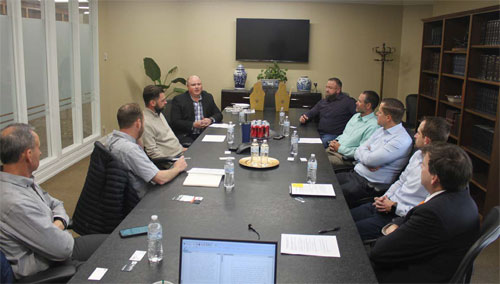 0, 90 percent complete before construction begins so that all the materials can be identified, and a lot of the information is now provided upfront so that actually we can get much closer on pricing, the project start times, scheduling — everything.
Mr. Alter: One thing we’ve found is that while the contractors like to see, during the schematic design phase, two or three options on things so that they can decide — we design as a team, the most cost-effective way, and then they have to kind of predict which ones are going to be the most available, whether it’s material issues or whether it’s local subcontractors who are capable of doing that work. And that seems to be more effective.
Also, the more sophisticated owners have a better understanding so that force majeure doesn’t even really come into play. They’re just basically saying, “OK, we can see that this is going to happen to you.” You know, maybe it’s a concrete supply issue, cement or whatever, and yet they know that’s the next step. So when you approach them with other options on how to get around that, whether we do something different on the project or not, to keep things moving forward, they appreciate that and they’re willing to be more flexible in that regard.
Mr. Scott: What labor-related challenges is the industry having right now?
Mr. Ketcham: Finding and retaining good people is really hard. From a designer’s perspective, that’s what I feel. You know, we had financial goals and so forth in the past, but now we have people goals. We want to hire so many people this year and try to grow our company as the market is growing, too. So reaching out to universities and other tech trade schools to find those people is crucial.
Mr. Gregory: I think, over the last few years we’re seeing a bigger influx of people coming back into the construction industry and seeing that as a good career path. We’re seeing more kids coming out of high school looking at the construction industry for career opportunities.
Mr. Wood: In the steel business, I foresee there’s going to be consolidation because it is difficult to find people so you’ve got to go buy another company that has workers and consolidate. We also have an aging population as well. There’s not a lot of young people wanting to become welders.
We are also seeing wage increases. We’re seeing we’re having to pay guys now the most we’ve ever paid anyone to make sure that they’re staying around. And then the last thing is I think the younger generation coming up doesn’t have as much loyalty intention as previous generations. They have lots of options. And so it’s a matter of how to creatively keep them employed and engaged and excited about the work and using other principles other than just compensation.
Mr. Moore: As a construction industry, we need to educate the younger generation what great opportunities there are in the construction industry. You go to college and you may end up with $200,000 in debt, or you go learn a trade, and in five years, you’re making $150,000.
Mr. Gregory: I think a key point is educating the educators. Help them see that the construction trades are a viable path for success in the lives of their students.
Mr. Hamson: We did a presentation for a school district in St. George and the guy presenting just talked about how great construction is and how you can make good money in the industry.
Mr. Scott: What role do you see immigration helping fill workforce needs in the construction industry?
Mr. Hamson: We just started a program bringing in immigrants and these guys are elated to start off making $18 an hour. It’s much more than they were expecting and hopefully it’s an effort that they’ll stay and we can retain them and they’re good hands. But immigration reform is huge for that because they are excited to work.
Mr. Scott: Let’s talk about Utah’s housing needs. There’s been an increase in multifamily housing here in Utah. Are you seeing that as a continuing trend in the foreseeable future?
Mr. Wood: Certainly. I feel like most of the younger generation, a lot of the old vision of the picket fence and the big yard and the big house is kind of waning. They’re choosing to live in better locations where they have outdoor locations, they have amenities. And so the multifamily housing is becoming more and more popular because it provides for that.
Mr. Gregory: I think that’s a factor, but I also think affordability is a big driving factor of it. I have kids who would prefer to be in a house, but they’re looking at what their options are, and there’s not a lot of options for affordability. If you look at some of the data, it shows Utah is still in a shortage. I don’t know when that flips and starts to drive down costs to where things are more affordable.
With the influx of people coming into our state, I’m not real optimistic it’s going to do that. So I think that’s going to be a challenge, is just affordability, and I think a lot of the multifamily is a solution. You know, people are moving in there because that’s what they can afford.
Mr. Gardner: Land supply’s only about a month and a half out. So if land supply’s only about a month and a half out, we can’t produce and we’re undersupplied, but we’re undersupplied almost two years’ worth of construct in front of us. And so you’re going to have this issue that’s going to be prevalent in the marketplace for several more years, just as things try to level off, let alone the growth of individuals who are immigrating into Utah itself in order to supply that. So it’s going to be really hard to suddenly resolve that issue just because demand drops due to pricing.
Mr. Moore: I’m curious to see what will happen as interest rates continue to rise, not only on the single-family home front — that certainly will affect the housing prices there — but also on the multifamilies.
Mr. Scott: How has technology impacted the industry?
Mr. Alter: I know from the design side, this is a big deal. The technology and how we’re collaborating with the entire design package now is all dynamic. As we design projects, it’s all part of a team approach and everybody’s in their own offices doing things on BIM 360, or whatever it is, and we’re working diligently to coordinate everything. And the intent is to get a more efficient design, and it’s also to get something for the contractors to bid that they can rely on.
Mr. Gardner: I’d also say what technology has done is allowed us to start building in more conditioned environments. Historically, construction has been performed mostly at the site. Using BIM or using some of these design technologies and being able to really model things up front allows us to push a lot of that into more fabrication facilities and more of a modular-type experience and bring it to a jobsite and have less constraints on the jobsite.
To me, that’s attractive both to a workforce who now we can bring into conditioned environments where they might not have been. And so that helps with some of that desire to enter into the workforce. It also helps solve typical constraints of schedule or quality and other aspects of the build.
Mr. Scott: So, you’ve seen BIM modeling working for subcontractors?
Mr. Gardner: We have. Our experience has been it continues to kind of trickle-down and very few contractors who are not experiencing benefits from it. Now, that is a biased view from a general contractor’s perspective. I want to believe that, but I can’t speak for them directly.
Mr. Wood: Technology’s helping us in kind of three ways. One is it’s enabling us to be able to do our takeoffs and our pricing much faster because we can templatize things and scan it through our processes and systems to kind of determine what all the pieces are in our scope. So that’s helping compress the timing of pricing.
The second thing is the coordination of drawings and updates is all done through centralized portals now. And so, whether it’s ProCore or this or that, you know, addendums and information coming through very quickly and emailing everyone on the team is very efficient.
And third, as people want more of this hybrid workplace, they want to work from home, they want to work from the office, they want to work from the jobsite — it enables that ability to kind of work from wherever. As you’re pulling up an iPad or a computer or laptop or a phone, we can send immediate drawings to a field guy that’s a hundred miles away, and he has the same information that we’re looking at on our screen instantaneously.
And so, whereas before, it was print off the drawings, send the drawings with the package, then they’ve got to make sure the drawings aren’t wet. And, you know, that’s all changing very real-time.
Mr. Alter: That’s one advantage I’ve seen, is with the younger generation are so savvy when it comes to the tech stuff, and it interests them much more than the older generation. And so these younger people are more willing to use tech to do what they do. And I think what we’re going to see in the construction industry, it’s been fun to get out in the field and see how creative contractors have been to rise to these occasions and use the tools that we have at our disposal to better do what we do.
Mr. Hill: That’s what I’ve seen out in the field mostly. It wasn’t long ago that we all had plans all over, and then it transitioned to every one of our supers had an iPad, And now I don’t know where all those iPads went because all they use is their phones. The communication is instant.
I think a couple things have driven it. One is the technology is available now. We have all these great apps and it’s constantly being updated. And the second is what you said, is this younger generation, they grew up doing everything on their phone. My kids still laugh when I grab my laptop. They’re like, “Why don’t you just do it on your phone?” They’ve grown up doing everything on their phones, and they’re demanding that in our industry as they come along.
Mr. Alter: One thing that I like is if you have plans even on a phone, you click on a detail and it automatically takes you to that detail. That is so much quicker than it used to be. It’s in their pocket, they pull something out and you can talk to them about a detail on site to say, “Let’s look at this wall section real quick.” They click on that and, boom, it’s right there.
Mr. Gregory: Now, with technology, the collaboration between our teams is moving a lot quicker because you send something out and everybody has it, they’re all on the same page. I think projects are getting a little more sophisticated and I think that’s going to drive more technology in the future and coordination.
Mr. Ketcham: I think technology is just speeding everything up. Everything is faster. I was in New York City last week with my daughter — she did a school trip there for her art class — and walking around the buildings that were constructed, you know, early 1900s, it’s interesting how you go through that and they tell you, “Oh, it took us so many years to build this building,” but then you see a more complicated structure that is taller and technically harder to build that was built in a matter of the months versus years.
And so I think the technology has enabled design to happen faster, it’s enabled that coordination.
Mr. Moore: I think everyone says it equals efficiency. We’re cutting out some efficiency issues. It also helps with the labor issue. As you become more efficient, you get those man- hours down and really help.
I’m excited to see what happens more into the future. We’re seeing some 3D printing happening. How does that happen on a larger scale? We see some self-driving vehicles. Farms are having some self-driving vehicles. I’m excited to see how that translates into earthwork and things like that.
Mr. Gardner: We really are on this precipice of a revolutionary experience in the construction industry. There are so many constraints that have pulled at us, and now we are seeing these tools that come with technology and these pulls that are required of us to change our thought and the way of doing business and the way we’ve always looked at solving problems, and it is going to be an amazing and really bright future in the next several years to see what construction was, and I think we will look back at the industry in five to 10 years and just marvel at, “I can’t believe we used to do things that way. Look at what we’re doing now.”
I think construction is that next industry to really experience some amazing changes in the way they do business.
Mr. Scott: Are you seeing things that are changing right now that you think are going to stick going forward and change how things are done?
Mr. Wood: One of the things we’re looking at within steel fabrication is that there’s a lot of machining that’s happening and automation that’s happening, and these BIM models are providing better cut sheets and pieces so that it can be watered down to be a lot less complicated.
So the tooling is increasing, the automation is increasing. Even robotics. There’s even robotics incurring, where before, you’d have to lift things with a forklift, and now you can move some things around a little bit easier inside there. So moving it to a modular construction into a controlled environment, and then the next step is automating some of that. So instead of 50 people in the shop, you need 10.
Mr. Alter: We did a project a while ago, and it was a large — it was on the Washington, D.C., temple, and they had to do a refabricating of the spire that supports the Angel Moroni, and it was kind of fun because we ended up going to the shop that was going to manufacture those revised parts up in Logan, and what we found was everything was done on a CNC machine. They took our drawings and literally fabbed up the parts and pieces. It was all robotic. And it was just fun. They let us watch some of this project go, and it took several hours for this machine to make it. But literally, they put the piece in there, the block of stainless steel, and had to fab it up. It was really neat.
Mr. Scott: Do you think that the construction industry needs to be more active in the political arena?
Mr. Gregory: I think yes. I think right now, we largely depend on some organizations like the AGC to advocate for us.
Mr. Moore: Yes. There are things that happen within our industry that we need a voice. And we have been doing that through AGC and ABC. There have been some leaders of some great companies here that have been very active in the political scene so that our leaders know their decisions they’re making, how that affects one of the biggest industries in any state.
Mr. Scott: What is one piece of practical advice that you would give to the young generation that may be considering a career in the construction industry?
Mr. Hill: I would probably counsel them to be patient and to learn. Spend as much time as you can in the field. Go ask an iron worker what he’s doing, go ask the surveyor what are all those notes on the grade stakes. So, really learning the industry, because there’s a lot to it.
Mr. Moore: I would echo that. Be a sponge. And more importantly, find mentors. Mentors is how we all got here. You cannot make up knowledge and experience in this industry. Finding mentors is really the best way to learn the industry.
Mr. Wood: I would add to that, don’t be afraid to get your hands dirty. Get out there and work with whatever product or material you’re working with so you get to know it. I started in the shop drilling, welding, grinding, sweeping. Get the skills as well as the knowledge in the industry.
Mr. Ketcham: I’d add one other thing is just be willing to change, open to change, adapt. I know some of the most valuable people we have working for us are ones that are willing to jump in and try something new or do something that isn’t in their job description.
Mr. Scott: What do you see is the biggest challenge facing the construction industry moving forward?
Mr. Moore: Leadership. Finding leaders that can solve some of these issues and really take the ball I think is going to be our biggest challenge, because the labor’s not going to go away, the supply chain’s not going to go away. We need to have the leadership within our industry to navigate that and get through that.
Mr. Hamson: Yeah, I agree with that a hundred percent. I mean, who’s your replacement? If you’re going to retire in 10 years, does this guy know everything you know in how to lead the company in 10 years? We’ve been really busy just trying to keep up with what we’re tasked with, you know, and finding your replacement is going to be a huge part of the success of everybody moving forward.
Mr. Alter: I would say the one thing I would think of is that we need to find the people that genuinely care about what they do and about their finished product, making sure that they take ownership.
Mr. Hill: Attracting the best talent. In Utah, that’s really tough when we’re sitting in this tech hub and guys can go work in shorts and flip-flops for 30 hours a week. It will be a challenge to attract the smartest people to come to our industry.
Mr. Scott: What is the future for women in the construction industry?
Mr. Moore: We’ve seen a lot of women that want to come to the construction industry, and we welcome it. We seek after women in our industry. Most the people we see that want to come to this industry that are women are incredibly intelligent and driven.
Mr. Gregory: I think part of it is back to educating and letting women know that there are opportunities within the construction industry. I wish I had an exact count, but we I think have around six or seven electricians that are female now coming through. A lot of our management and even our executives — my top executive team are women, and they’re phenomenal in the workforce. I think, for some women, they just don’t see that as a career path and I think we need to show women the many opportunities available to them. We need them.
Mr. Gardner: Perception is a real thing, and I would just give kudos to Utah. There is a professional women-in-building group in Utah. Recently, a group of all female contractors built a home in Utah. That’s a huge accomplishment, and we should promote that as an industry. We should tell people about that and help people to see the path that it can be in construction and encourage those, you know, young children to adults that are women to say, “We need you in the industry and there’s a place for you and you’re valued here.”
Mr. Ketcham: I think that women are definitely needed. I think being creative as management to provide those paths and those opportunities and the different flexibility in the workplace to allow more women in the workplace is something that we can all do better.
Mr. Wood: We’ve really enjoyed having women in our shop and in our field. In fact, they’ve been some of the best from a precision and taking care and consideration of the end product.