
The strength of Utah’s Dixie is in its planning
Born in 1850 in Switzerland, 9-year-old John Stettler Stucki arrived in Salt Lake City after walking across the plains with his family and other pioneer settlers. His time in northern Utah was short, as Brigham Young had a role for his family: colonizing a new settlement located 300 miles south, near present-day St. George.
 As documented by the Washington County Historical Society, Utah’s Dixie was settled deliberately and by design, early in the state’s history. A short time after the pioneers first entered the Salt Lake Valley, LDS Church Pres. Young sent Parley P. Pratt and several men to explore the Virgin River Basin and evaluate the potential for colonization there.
The outbreak of the Civil War in 1861 presented nationwide economic disruptions to the textiles and cotton industry, and Brigham Young recognized the opportunity for Utah saints to grow and sell cotton.
John and the Stucki family were sent from Salt Lake City to settle with other Swiss saints in Santa Clara. Preceding the Swiss, as many as 40 other families had been directed there by Young. Hailing from the southern United States, these families possessed the specific knowledge and skills to grow cotton. Paying homage to the nickname of their former home, these settlers called the region “Utah’s Dixie.”

A paddleboarder enjoys one of the unique opportunities available in Washington County at Sand Hollow Reservoir.
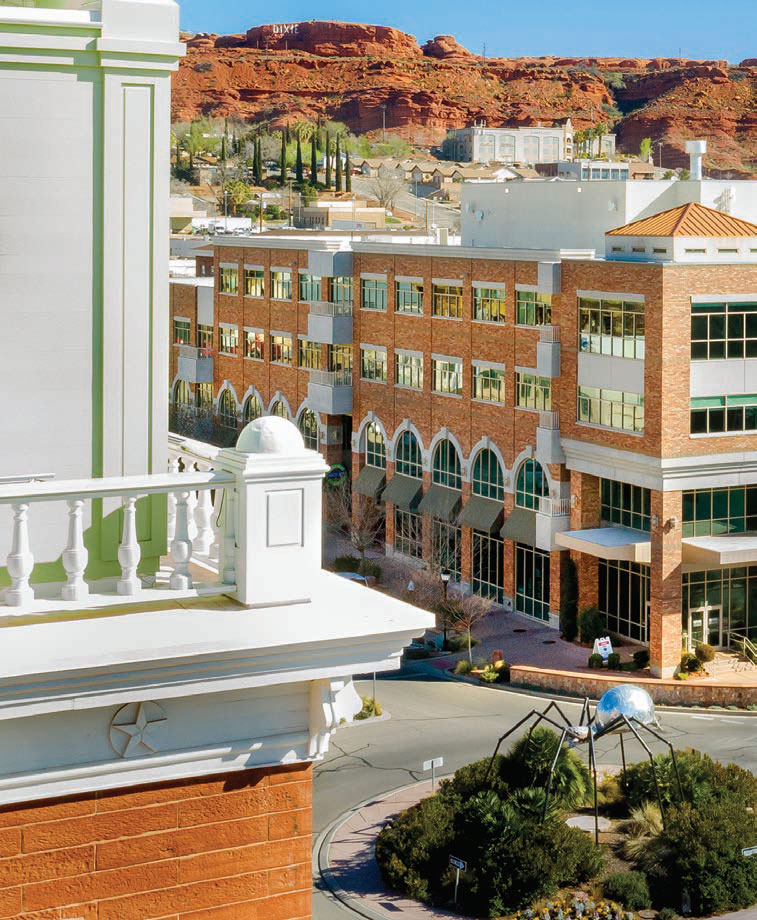
Downtown St. George is always growing. This four-story, Class A office building is seen from atop the historic St. George Tabernacle.
The first extensive manufacture of cotton cloth began in 1865 when a cooperative cotton factory was organized under the direction of Young. This meant the cotton lint would not need to be baled and sent to others to produce cloth. The enterprise required the construction of a mill and the installation of the necessary machinery. A site in modern-day Washington was selected because of nearby water power from the Virgin River. However, soon after, the Civil War ended, restoring the national cotton supply and the economics no longer justified growing cotton in Utah’s Dixie.
But the community, new infrastructure and a hard-work ethic were here to stay.
Today, the cities and communities of Washington County are as diverse as the first settlers. Generations of early settlers have labored to build their legacies as well as the local economy. The county population has grown from 691 people in 1860 to an estimated 172,000 today.
Just as Brigham Young foresaw opportunity there in the 1860, others have recognized Dixie’s unique potential throughout the years and have used thoughtful planning to guide the area’s growth. In recent years, the area economy has been boosted by several influences, including a rapidly expanding state university, atechnical college, year-round tourism opportunities, a regional airport and national housing trends like the “Great California Exodus.”
Washington County is fast becoming Utah’s year-round recreation capital. Tourism is thriving, thanks to the abundance and variety of nearby activities. Nearby Zion National Park attracts 4.3 million visitors each year, a number that jumped nearly 60 percent in the past decade. Currently, Zion ranks as the fourth-most-visited national park, ahead of Yellowstone (fifth) and Yosemite (sixth).
But it’s not just Zion. In recent months, Utah’s Dixie has solidly established itself as a contender for OHV and off-road vehicle recreation. Featuring warmer temperatures and drier weather, it’s also less-crowded and more easily accessible than Moab. The Sand Hollow OHV area covers 15,000 acres of breathtaking scenery and desert life. Sand Hollow State Park is one of Utah’s newest, supporting year-round activities, including national endurance competitions, bringing athletes in from around the world to compete and train. Snow Canyon State Park provides endless trails for wandering among sandstone dunes and cliffs, with some of the most beautiful scenery in the region. And the nearby state parks of Quail Creek and Gunlock reservoirs feature picturesque opportunities for camping, fishing and boating.
Small-business owners Bill and Michelle Ennis opened Washington County’s first water paddle sports shop in 2011, providing rentals at Gunlock Reservoir and Quail Creek Reservoir. Growth exploded at first, and has produced a predictable 15 percent to 20 percent growth rate in the most recent years, said Bill Ennis, selling goods and services to “residents, tourists and tourists who become residents.” Similar success has been achieved by other small-business owners in Dixie, from dentists and graphic artists to restaurant operators.
The Dixie Metropolitan Planning Commission has projected substantial growth for the region, as people representing a broad demographic continue to relocate to Dixie. One of the many influences is the activity of the airport. Formerly located on top of a land-locked mesa above downtown St. George, the city airport was unable to grow. It was closed in 2011 and moved to an empty plot of land several miles away. To promote additional growth and attract more regional flights, the airport changed its name to St. George Regional Airport. SkyWest Airlines is headquartered in St. George and operates from 10 national hubs, providing more than 2,200 flights per day. From the St. George regional airport, they’ve added connections to several international airports like Denver, Los Angeles and Salt Lake City, effectively connecting St. George to the world, with only one stop.
But perhaps the biggest economic boost of relocating the airport was the land it deserted. The city of St. George recognized the opportunity for redevelopment and worked to guide the creation of a long-term master plan for the abandoned airstrip overlooking the city. Dubbed the “Tech Ridge” development, the once-dark mesa now hosts the new main campus of Dixie Technical College. One of the next parcels to develop is adjacent to the college and will be the new headquarters for two tech companies, earning the attention of other entrepreneurs and firms that are seeking lower operational costs and an improved work-life mix.
Throughout Dixie there are more than a half-dozen large, mixed-use developments in progress, including the explosive growth surrounding I-15’s Exit 2.
In its relatively short history, Utah’s Dixie has seen remarkable but sustainable economic growth. With vision, planning and leadership, it’s positioned to be a foundation for regional growth for generations to come.
Chris Knoles is the director of marketing for Zwick Construction Co.. He’s a descendent of John Stucki, one of the first settlers of Utah’s Dixie.