
Striking a balance
With settlement discussions underway regarding a proposal from Rocky Mountain Power to alter the rate structure for residential solar customers, many solar companies, interest groups and individual customers are speaking out against the proposed changes.
The catalyst for the proposed rate change was simple, said Dave Eskelsen, company spokesman for Rocky Mountain Power: The current rate structure for residential customers who generate solar energy is not fair to non-solar customers.
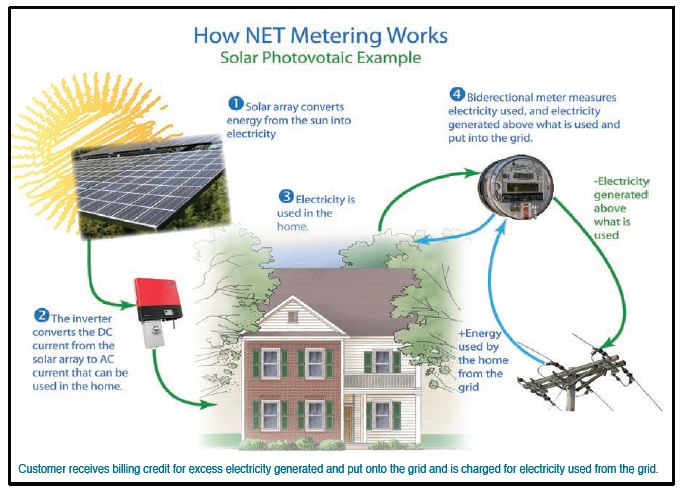
Residential solar customers are currently part of a program called net metering. Started in 2002, the program was “designed to make an allowance for customers who wanted to produce some of their own energy while maintaining their connection to the utility company,” Eskelsen said. A special meter installed on the customer’s property measures how much energy the customer creates on their own and how much energy they consume from the utility company, and then calculates the net, or difference.
In 2008 the program was altered to give residential net metering customers a credit — at the retail price — for the energy they produced in excess of their consumption.
However, the cost to the utility of providing electricity is more than just the cost of the energy itself, Eskelsen said, and the credit system for net metering solar customers created a shortfall in revenue used for administrative and maintenance costs that apply to all utility customers.
Rocky Mountain conducted a study that found a typical rooftop solar customer underpays their actual cost of service by about $400 per year. This shortfall is currently shifted to other, non-net metering customers who are subsidizing $6.5 million each year. That number could grow to as much as $78 million annually if the rate is not addressed. Over the next 20 years the cost shift to other custo,mers is estimated to be about $667 million, the company said.
And that subsidy, Eskelsen said, is what makes the current rate structure unfair.
“We’ve determined that net metering customers are a different kind of customer and they deserve a different rate,” Eskelsen said. “It’s fair for other customers and it’s fair for the net metering customer. Our only object here is to come up with a rate that is fair to everyone and that covers the cost of providing service to different kinds of customers. As long as everyone uses the utility basically the same, [it’s] not a problem. But the way a net metering customer uses the utility is fundamentally different.”
Under the proposed new structure, rates for residential net metering customers would be divided into three parts: a fixed charge of $15 that covers the administrative and maintenance costs not being supported by the current net metering program, a $9.02- per-kilowatt charge for energy used during peak periods and a 3.81-cent-per-kilowatt charge for energy used outside peak demand hours.
The new rate structure is in line with the rate structure applied to industrial and commercial utility customers, and would only apply to new net-metering customers, Eskelsen added. Customers who are already part of the program will continue with the original rate structure.
Solar companies argue that the proposed changes will discourage new solar customers entirely.
“The solar industry in Utah exploded because of a simple financing option that allows customers to replace their power bill with nothing out of pocket. The proposed rate structure would double customers’ monthly payment in some cases, effectively eliminating that option,” said Jess Phillips, CEO at West Valley City-based Auric Solar. The company is one of the parties currently involved in settlement discussions about the proposed changes. “We think it’s reasonable for solar customers to pay either a one-time or monthly fee to pay their fair share for maintenance. Anything more than that doesn’t make sense. Most studies conducted across the U.S. have found that rooftop solar creates a net gain when it comes to utility costs and maintenance.”
Fewer solar customers creates an economic threat to the companies that support them, Phillips added. He cited a similar rate change proposal in Nevada that wiped out 99 percent of solar companies operating there. It has since been overturned.
“The public has demanded that solar must be an option and recently the Nevada Legislature passed a bill to bring back solar power net metering to Nevada,” he said.
Nonprofit groups also oppose the proposed rate changes. The Utah Solar Energy Association (USEA) is currently hosting a petition on its website called “Help Save the Future of Solar in Utah.”
“The adverse impacts of Rocky Mountain Power’s proposed rate increases cannot be overstated. It will kill consumer choice, economic growth, the solar industry and thousands of Utah jobs,” the website states.
And USEA is not alone in its opinion. The organization recently commissioned a survey, conducted by Dan Jones & Associates, that found most Utahns agree the proposed rate structure discriminates against customers with rooftop solar generating capabilities, though, of the 834 respondents, the vast majority (94 percent) do not have their own solar energy system.
The survey also highlighted the concern that a rate structure that discourages new solar customers will have a negative environmental impact. More than 80 percent of survey respondents said improved air quality (84 percent) and a cleaner environment (83 percent) are the most important factors when considering new solar rates. USEA said the study Rocky Mountain Power is using as a basis for its rate change proposal takes into account only costs and not other tangible and intangible benefits of solar power. USEA maintains that a study with a long-term view of generational costs and benefits of solar, especially the environmental benefits that are most important to Utahns, should be conducted.
Solar providers such as Auric Solar agree.
“Solar power uses the natural resource of the sun to produce clean, reliable and renewable energy. It’s hitting our rooftop every day for free. It’s a convenient and clean source of electricity that we are wasting if we don’t tap into it,” Phillips said. “A clean, reliable and renewable resource like solar energy is smart for the environment. We’ve got to do something to clean Utah’s air — and reducing our dependence on coal will make an immediate impact.”
Utilities are not trying to eliminate solar growth, Eskelsen argues. They are simply trying to find a rate structure that is sustainable and equitable. He said utilities in Arizona and California have experienced distribution disruptions as a result of revenue shortfalls caused by net metering, and Utah utilities are eager to avoid the same pitfalls. Simply put, net metering as it stands is not a financially sustainable model for utility companies in Utah, he said.
“The pace at which net metering was growing prompted us to solve this problem before it became an issue,” Eskelsen said. “If net metering continues to grow, it could become a problem. We want to be ready with a pricing scheme that makes sense for everyone.”
He added that the proposed rate structure will not increase the company’s revenue, but will simply address current budget shortfalls in a more equitable way.
A large group of stakeholders — including utilities, solar companies and environmental and clean energy special interests — are currently involved in settlement discussions with the goal of reaching an agreement about the rate changes, which could take the form of a new or altered rate proposal. From there the proposal goes to the Utah Public Service Commission (UPSC), which can accept the proposal, reject it or suggest additional changes.
“The standard for the commission is that it is generally in the public interest,” Eskelsen said.
And despite current disagreement about how to go about it, traditional utilities and solar energy advocates agree that public interest is and should be everyone’s goal.
“The world is changing. We are smarter and we no longer can operate on non-renewable energy,” Phillips said. “Finding a solution that works for both utilities and solar companies is the best decision for our economy and community.”